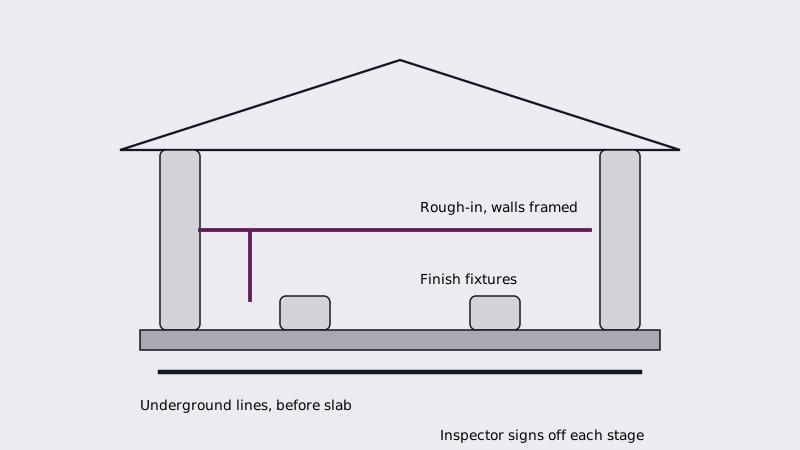
Plumbing for a new Murrieta house is paid in stages that track the build. Underground pipes come first, ahead of the concrete pour, then rough-in after the walls are framed, and finish work when fixtures are installed. Each stage has its own price and its own inspection. We do not post a per-square-foot figure that nobody has sourced; a plumber bids your plans. For other jobs, start at the Murrieta Creek Plumbing home page.
How is the plumbing in a new home divided into stages?
Three stages make up the job. Underground or under-slab work lays the drains and sleeves before concrete. Rough-in, also called top-out, runs supply and drain pipes through the framed walls and ceiling. Finish, or trim-out, installs toilets, sinks, faucets, the heater for hot water, and the hookups for appliances. An inspector signs off at each stage.
Pricing follows the same split. A plumber may bid the whole house at one fixed amount, divide it by stage, or price per fixture with extras for gas lines, a water softener or a recirculation loop. Ask for the bid in stages, which shows where the money goes and lets you compare two bids evenly. Payments tied to inspections are safer than payments tied to the calendar.
Underground work is the stage you cannot fix cheaply later. Check the drain slope, the cleanout locations and the water and gas sleeves before the slab goes in.
What affects the plumbing price of a new build?
The main drivers are how many bathrooms and fixtures there are, the house's size and layout, one story or two, the distance from the meter and sewer, the water heater type, gas lines, materials, and the local permit fees. A compact single-story plan with bathrooms back to back costs less than a sprawling one with scattered wet rooms.
Plumbing in two-story houses needs vertical runs and more venting, and a kitchen on an island with a sink and dishwasher needs extra planning for drains and vents. A house with a pool, outdoor kitchen or casita adds more. Copper costs more than PEX for supply lines. Add a tankless heater, a softener or a laundry on the second floor and the total moves again.
Hard water is a design question. Third-party estimates commonly rate Murrieta tap water moderately hard to hard, so plan for a softener loop or space for one before the walls close. See water softener installation.
Who covers the water and sewer connection fees?
The water or sewer district, not the plumber, charges for the meter, connection and sewer hookup, and the owner or builder pays. Your address decides the district. EMWD serves much of Murrieta, but other districts cover parts, so ask which one bills your lot.
A few districts supply Murrieta water; Eastern Municipal Water District is the most common, and the bill shows which one serves you. EMWD lists French Valley and Winchester among its communities, and Wildomar is usually served by Elsinore Valley Municipal Water District, but confirm for your lot. Fallbrook, De Luz and Rainbow have their own districts. Fee schedules change and differ by district, so get the current numbers from the district office, not from an article.
On rural lots without sewer, a septic system or a well adds large costs that sit outside the plumbing bid, with separate permits from the county. We have not verified septic rules for each area here, so ask the county office.
Which building office issues the permit?
Within the city, the City of Murrieta Building and Safety Division takes permit applications, at 1 Town Square, listed at 951-461-6062. Wildomar runs a separate Building and Safety office on Clinton Keith Road, listed at 951-677-7751. Unincorporated French Valley and Winchester fall under Riverside County, while Fallbrook, Rainbow and De Luz fall under San Diego County.
We found (951) 955-1800 for Riverside County Building and Safety and (858) 565-5920 for San Diego County Building Services, but those county sites did not load when we checked, so confirm before you call. A permit covers the whole plumbing scope, and the inspections happen at the stages above. The plumber on a new build usually pulls the permit under their contractor license.
In California a contractor license is generally needed once a job reaches $1,000 or more in labor and materials, or whenever it needs a permit. Check one through the state board's hiring a contractor page, and get a written contract before paying anyone.
Should you hire a plumber directly or go through the builder?
If a builder or general contractor runs the project, the plumbing is in their contract and usually subcontracted. If you manage the build, you hire the plumber, who bids against the plans. Direct hire lets you compare and choose fixtures. Builders can bundle trades, which may simplify things but can hide the split.
Whichever plumber you pick, collect the contractor license number, proof of insurance, the schedule, who supplies fixtures, who handles the permit and inspection, and what is excluded. Payment schedules should follow inspected work and be within the state's deposit limit.
If you are buying a new house, not building one, the stage prices matter less, but a plumber can still check the system before the builder's warranty period ends. Many Murrieta neighborhoods date to about 2000 or later, and even a newer house deserves a pressure check, plus a look at how the water heater is strapped.
Which extras do people tend to overlook?
Hose bibs, where the pressure regulator and main shutoff go, a gas stub for a range, dryer or barbecue, a drain for the water softener and the water heater pan, cleanouts, a laundry box, outdoor sinks, and recirculation lines. Each is cheap at rough-in and costly to add after the walls are closed.
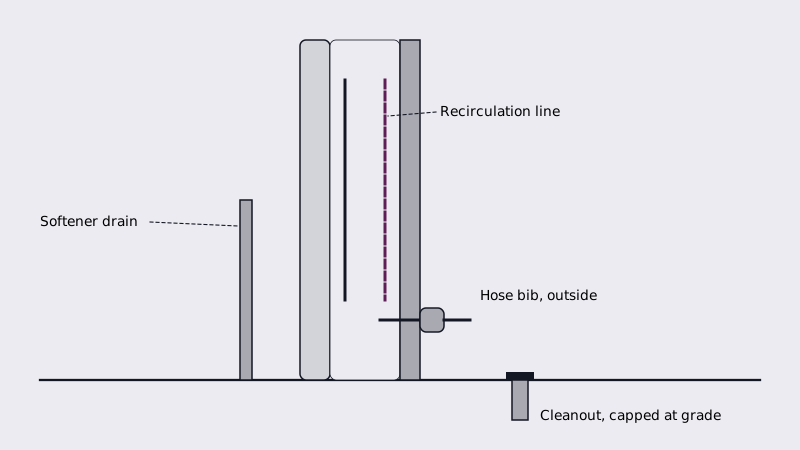
Add rough-in for a future bathroom if you might finish a room later. Ask for an earthquake gas shutoff valve at the meter side if you want one; see earthquake gas shutoff valves. Ask whether the water heater location allows a tankless unit later. A gas line sized for tankless now is less expensive than upsizing it later; our gas line cost page explains how gas work is quoted.
How do you compare bids for a new house?
Request bids against the same plans, in writing, by stage. Compare fixture allowances, pipe materials, what is excluded, permit handling, warranty on labor and the payment schedule. Be careful with a bid that is far below the others, since it may leave out items that return as change orders.
See also what a plumber costs in Murrieta for how hourly and flat pricing work, and what a plumbing inspection costs. We arrange the visit; the local business that comes out quotes the work, and it pays us a fee for the request. Tell us about the project on the price request page.
Common questions
How much will plumbing a new house run me?
Size, bathrooms, stories, materials and permits all play a part, and we will not offer an invented number. Have two or three plumbers bid the same plans in stages, then compare the line items. A bid is firm only when drawings stand behind it, not a phone description.
Do plumbers charge by fixture or by square foot?
Both methods exist. A per-fixture bid counts toilets, sinks, showers and appliances, then adds extras. Per-square-foot figures are rough rules of thumb that ignore layout. A bid by stage from the plans is more useful, because each line can be compared with another bid.
Is a separate plumber needed for gas lines?
Not always, because many plumbers do gas piping, though California demands a contractor license for the work, and the lines need a permit and inspection. Ask whether the gas work is inside the plumbing bid. Smell gas? Leave first, and once outdoors ring SoCalGas at 1-800-427-2200.
When should I pay the plumber?
Tie payments to inspected stages. California limits down payments, so be careful with anyone asking for most of the money up front. Keep copies of the contract, permits and inspection sign-offs, and do not make the last payment until the final inspection passes.
Does a new house still need a plumbing check?
A quick check is worth it. Builders' crews work fast, and a plumber can test pressure, hunt for leaks, inspect the expansion tank and regulator, and confirm the water heater is braced. Do it before the builder's warranty runs out so any defects are covered.
Last changed