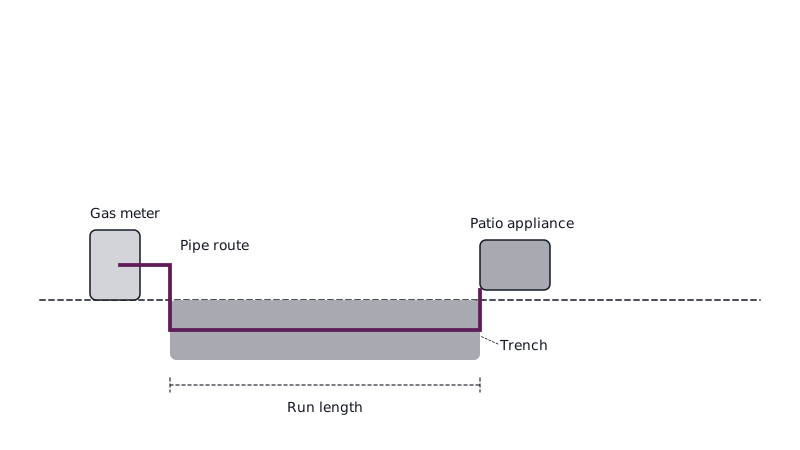
Gas line pricing depends on length, pipe type, trenching and the permit, not on a single flat fee. According to a published guide, a new run for a stove, dryer, furnace or water heater costs about $20 per linear foot with materials and labor, while repairs start at $120 behind a stove and reach $1,500 to $5,000 for a buried line. The gas line plumber page describes what the work involves.
When gas is in the air, get everyone out of the house before doing anything else. Next, phone SoCalGas at 1-800-427-2200 from outside, or 911 where someone is in danger. Do not search for the leak yourself.
What does a gas pipe repair cost?
In the guide, a repair behind a stove is $120 to $250, a leak inside a crawl space or wall is $270 to $760, and a buried line is $1,500 to $5,000. Replacing a section costs roughly $8 for each linear foot. Those numbers are national, so what matters is a local quote given after a pressure test.
What makes a repair cheap or costly is access. A flexible appliance connector behind a range is a short job. A weep at a joint inside a wall means opening drywall, repairing it and closing it again. A buried line means a trench, which in Murrieta can include a concrete patio or a slab edge.
Leave gas repairs to the trade. California requires a contractor license for gas piping, and a repair that touches the system generally brings a permit and an inspection. A lit match or lighter must never be used to look for leaks.
What do plumbers bill for running a new gas line?
The same guide gives about $20 per linear foot, labor included, for a typical new line to a dryer, furnace, stove, water heater or pool heater. Fireplaces run about $15 to $25, and a fire pit, grill or generator $20 to $25. Depending on depth, trenching adds $4 to $12 per foot.
Use this as a quick sum: a 25-foot extension to a patio barbecue lands around $500 plus a permit and inspection, and a trenched route through a yard goes higher. A line to a new outdoor kitchen on a lot with block walls or hardscape changes the arithmetic, since the plumber may route through the attic or along an exterior wall rather than dig.
Pipe material changes the price too. The guide lists materials only, per foot: CSST (flexible corrugated steel) $2 to $4, black iron $4.90, galvanized steel $2 to $9, copper $1 to $3 and stainless $2 to $5. What gets used depends on the code, the gas pressure and your gas company's rules, and the plumber chooses. Read about flexible gas line sizing and the codes for residential gas piping.
How much do permits and inspection add?
A plumbing or building permit is $100 to $300 in the guide, and an inspection is $50 to $75, sometimes up to $300. Around Murrieta, a permit inside city limits is issued by the City of Murrieta Building and Safety Division (951-461-6062), and in unincorporated French Valley and Winchester by the county.
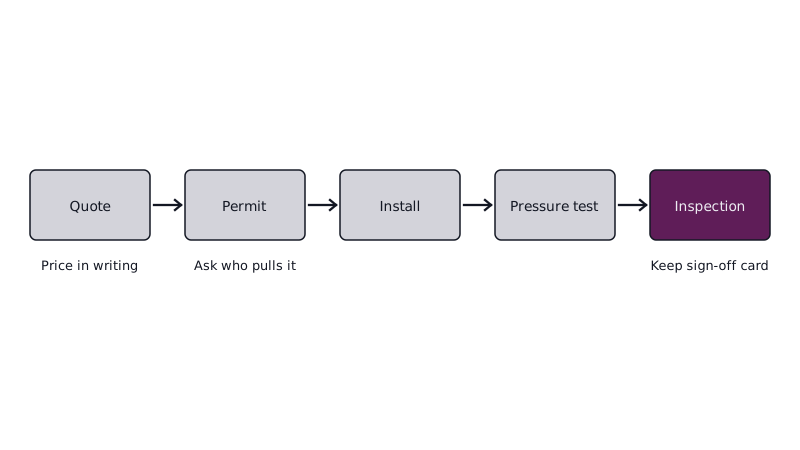
An inspection matters. It is the check that the new pipe holds pressure and that the connections are tight, so it protects you more than anyone. A quote that says "no permit needed" for a new gas run is a warning sign. Ask which party pulls the permit, and keep the final sign-off card.
Gas service area: in Murrieta and nearby communities the gas company is expected to be SoCalGas, if your street has gas service. Some rural homes run on propane or electric instead, so work out what you have first, then request a quote. Homes around Fallbrook, Rainbow and De Luz may have a different gas supplier, so check your bill.
What is a gas plumber's hourly rate?
Plumbers are listed in the guide at $45 to $200 an hour. The wide gap reflects the region, the type of job and whether the business bills a minimum call-out. Gas work often gets quoted as a fixed price for the whole run instead, which is easier to compare. See hourly plumber rates and the page on plumber costs in general.
Clarify whether the price is hourly or fixed, whether pressure testing is part of it, and whether materials are billed on top. The business must hold a California contractor license, and the Contractors State License Board lets you check it.
What should an earthquake gas shutoff valve cost to install?
We found no sourced figure to quote here; request a written price. A seismic shutoff valve shuts the line on its own once the ground shakes hard enough. Installation is on the meter or on the house side, and a permit may apply. Read about how it works and where it goes and why people fit one.
Look at the visit rather than the part: the quote should name the valve, say who installs it, and say whether the gas company needs to be involved. Only the gas company can work on its meter.
When you are ready, submit a quote request giving the length of run, the appliance and the route. Local plumbing businesses receive it and pay this site a fee for introductions; whichever one replies gives the quote and carries out the work. Our other services are listed on the home page.
Common questions
Is natural gas pipe cheaper than copper or flexible tubing?
Per foot, the guide lists copper at $1 to $3 and CSST at $2 to $4 for materials only, but price is not the choice. The code and your gas supplier decide which pipe can be used where. Labor, trenching and the permit are a bigger part of the bill than the pipe itself.
How long does a gas line job normally last?
A short repair or a new appliance connector can be finished in a few hours. A longer run involving trenching, pressure testing and inspection needs a day or more, with the inspection booked separately. Expect the plumber to name a time frame once the route has been seen.
What do I need ready for the plumber's visit?
Be clear on the appliance being connected, the location of the meter and main shutoff, and the route you prefer. Photos help. Leave clear access to the meter and the work area, and mention any pets. If you smell gas, do not turn gas valves yourself.
Must an adult be present while the work is done?
Yes, at the beginning and the end, since gas work involves shutting off and relighting appliances, and the inspector may need to get in. The plumber also tests appliances indoors afterward. When you cannot be present, sort out access beforehand.
Last changed