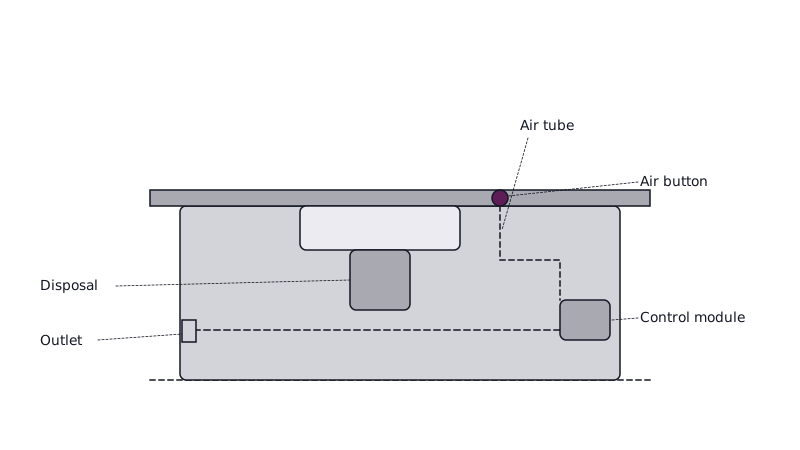
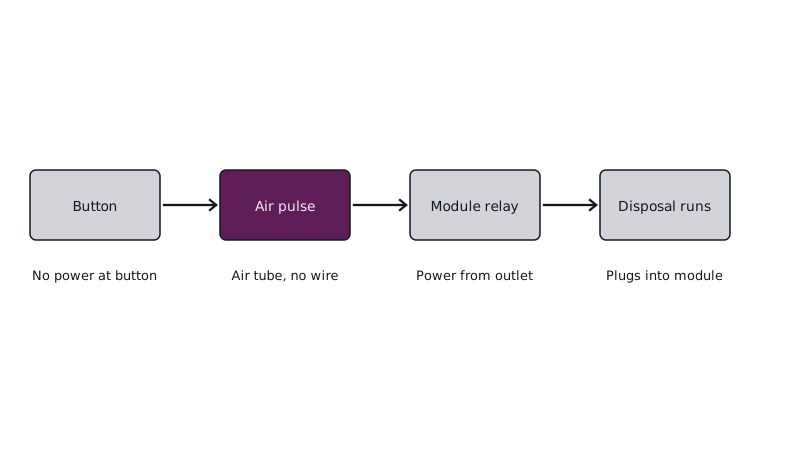
An air switch is a push button on your sink or countertop that connects by a thin air tube to a small control box under the sink. Pressing the button sends a puff of air along the tube, and the disposal starts. The button itself carries no electricity, so power stays away from wet hands. A hole, a tube and a plug-in module are all an install needs. For the wider picture, see our faucets, sinks, showers and disposals page.
What is an air switch and how does a garbage disposal use it?
It is a pneumatic switch. The button on the sink or counter squeezes a short bellows, and the air pulse closes a relay in a module under the sink. The module plugs into an outlet, and the disposal plugs into the module. Since no electrical wire runs to the button, plenty of people prefer it for sinks and counters.
Parts in a typical kit:
- The button, which goes through a hole in the sink rim or countertop.
- A flexible air tube that runs down to the module.
- The control module, sometimes called the power unit, which mounts under the sink.
- A power cord from the module to an outlet, and a cord from the disposal to the module.
Kits differ. Some are made by the disposal maker, others are universal. Check that the one you buy matches your disposal's electrical specs and the plug type. Some disposals are wired straight into the house circuit and have no plug, which changes the job.
What should you settle before drilling the countertop?
Work out what the top is made of and where the hole will go. If the sink has a spare faucet hole or soap dispenser hole, the button can sit there and no drilling is needed. A standard bit handles a new hole in laminate. Granite, quartz and other stone call for a diamond bit, and one slip can crack the slab.
Plan these details:
- Hole size. Buttons usually need a hole of about an inch and a quarter. Check the instructions in your kit.
- Position. Leave room under the counter for the nut and tube. Cabinet frames and drawers can block it.
- Distance. The tube has a limited length, so the module sits near the button. Do not stretch it.
- Material. Stainless sinks can be punched or drilled with the right tool. Stone and solid-surface counters are where mistakes cost money.
If you have granite or quartz and no spare hole, hiring a fabricator or a plumber who drills stone is worth it. A cracked countertop costs far more than the kit.
Can I install the air switch myself?
When the disposal already plugs into an outlet and there is a spot for the button, many homeowners go ahead. The skill level is about that of hanging a shelf and fitting a faucet. If the disposal is hard-wired, or the wiring is old or unsafe, bring in a contractor, because electrical work needs a license when a permit is required.
DIY steps, in brief:
- Unplug the disposal, and switch the breaker off before you touch a thing.
- Secure the button with its nut, and run the tube beneath the sink.
- Mount the module high and dry, clear of the drain and supply lines.
- Connect the disposal's plug to the module, and the module's plug to the outlet.
- Test it by pressing the button while water runs and the drain is empty.
Water and electricity are a bad mix. Keep the module off the cabinet floor and above any place a leak might pool. If your outlet is not GFCI-protected, ask a contractor about adding protection. Kitchen countertop outlets are generally required to be GFCI-protected in current code, but older homes vary. Older houses can still carry older wiring.
When should a plumber or electrician do the work?
Bring in a professional if the disposal is hard-wired, the cabinet has no room, no outlet sits beneath the sink, or you have stone countertops and no existing hole. Also call if the sink drain leaks or the disposal is failing, since a switch will not cure a worn unit.
A plumber can fit the switch along with a new disposal and drain connections. An electrician who holds a California license is the right person for wiring changes. Should a permit be needed, inside the city it comes from the City of Murrieta Building and Safety Division, and county offices cover unincorporated areas. Ask which applies at your address.
Combine the work where you can. If a new disposal is on the list, read about garbage disposal installation service. For other kitchen drain troubles, see unclogging a garbage disposal drain.
Why does the disposal not start after fitting the switch?
Usually one of three things: a loose air tube joint, a module plugged into a dead outlet, or the disposal's own overload having tripped. Look at the tube connections first, then the outlet, then push the reset button, which is red, under the disposal. A hum without spinning means it is jammed.
Quick checks, in order:
- Tube. Make sure it is pushed fully onto the button and module fittings, without kinks.
- Outlet. Plug in a lamp to confirm it has power. A tripped GFCI is common.
- Reset button. On the bottom of most disposals. Press once.
- Jam. Turn power off and use the hex socket in the underside to free the flywheel.
- Module. If everything else is fine, the module may be faulty.
If a disposal leaks, rattles or smells, look at the unit itself. Our guide for disposal repair covers it.
How do I get someone to fit it?
Tell us about your sink, the countertop material and whether the disposal plugs in or is hard-wired, using the quote page. Requests are handed to local plumbing businesses that pay us a fee, and the business that visits sets the price. The Murrieta Creek Plumbing home page shows what else we handle.
Common questions
How long will the work take?
With a spare hole and a plug-in disposal, often under an hour. Drilling stone, or sorting out a hard-wired disposal, takes longer. A new disposal fitted at the same time adds time for drain connections and testing. A photo is enough for the plumber to estimate the time.
What should I look at in a kit before buying?
Check that it works with your disposal's power, plug and wiring, that the hole size fits your sink or counter, and that the tube is long enough to reach the module. Look at the cord length and whether a plug-in or a hard-wired model is described. Keep the instructions.
Does an air switch make a disposal safer than a wall switch?
Nothing live sits in the button, so wet hands never touch an electrical part, which is the main appeal. It does not remove the risk of the disposal itself, so keep hands out of it and unplug before reaching in. Neither type replaces proper wiring.
Do I need an air switch if I already have a wall switch?
No. It is a convenience, not a requirement. Many people add one because the wall switch is far from the sink, or because children or visitors might hit it by mistake. If your wall switch works, you can leave it as it is.
Last changed