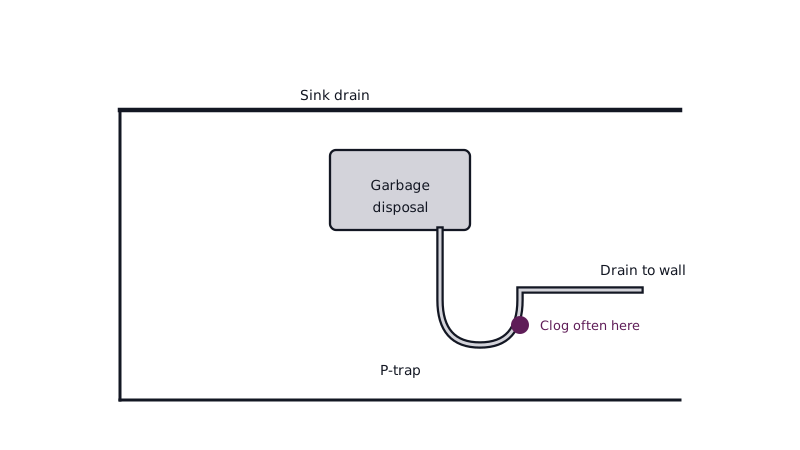
First rule: keep your hands out of a disposal at all times, switched off or not, and do not run it while you work. Turn the wall switch off and, better still, pull the plug or trip its breaker. Then work out which problem you have, since the fixes differ. A hum with no spin is a jam. A blade that spins while water stands in the sink is a clog beyond the grinder. Drain trouble across the house is a clogged drain issue, covered separately.
How can you tell a jammed disposal from a clogged drain?
Run a little water and flick the switch. A low hum while the blade stays still is a jam, and the reset button underneath has often popped. If the blade turns freely yet water stays in the sink or rises in the second basin of a double sink, the blockage lies past the disposal, either in the trap or deeper along the line.
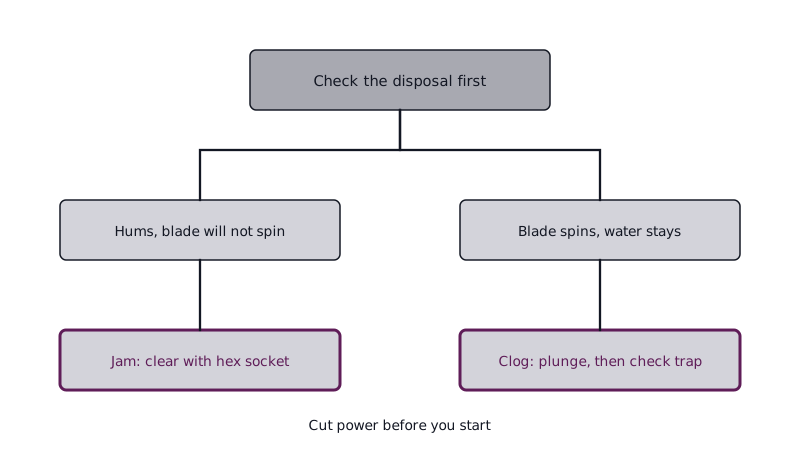
Treat them separately. A jam is mechanical: a bone, fruit pit, bottle cap or a lump of rice has locked the flywheel. A clog is a matter of grease, coffee grounds or starchy paste that has packed the trap. Gurgling from the dishwasher or water bubbling up in the other bowl are also hints that the drain downstream is slow.
How do you free a jammed disposal?
Disconnect power first. Find the hex socket at the center of the unit's underside and rock an Allen wrench, usually 1/4 inch, back and forth in it until the blade rotates freely. From above, pull out anything visible with tongs or pliers, never fingers. Press the red reset button, turn the power back on and test while cold water runs.
If the wrench will not turn at all, something large is wedged in. Do not force it, because stripping the socket makes things worse. If a unit hums, resets and trips again right away, the motor may be failing. A disposal that has run for ten years or more is often cheaper to replace than to repair; see garbage disposal repair for how that call is made.
Run plenty of cold water through a freed disposal. Cold keeps grease firm so it is chopped and flushed away, while hot water melts it and lets it stick further down the pipe.
What can you do when the sink will not drain at all?
Begin with a plunger. Block the other drain of a double sink with a damp rag, seal the dishwasher line with a stopper, let roughly two inches of water collect in the sink, and plunge firmly for fifteen to twenty seconds. If water drops, you have cleared a soft clog. Repeat a few times, then run hot water.
If the plunger fails, check the disposal's baffle and the area just below it for packed food. Put the power off and look in with a flashlight. Remove the P-trap only if you can place a bucket and rag under it, since it holds dirty water. Hand-turn the slip nuts until they come off, empty the trap, rinse it and look along the pipe that heads into the wall.
If a kitchen line clears and then clogs again, grease further down is the likely cause. More steps appear in clearing a kitchen sink and clearing any household drain.
Does the dishwasher drain make this worse?
Yes, it can. A dishwasher drain hose connects to the disposal inlet or to a spot on the sink drain. If the knockout plug inside a new disposal was never punched out, the dishwasher cannot drain, and the water backs up into the dishwasher. If the hose is kinked or clogged, you see the same sign.
Run the dishwasher while watching the sink. Water rising in the sink during the drain cycle means the shared line is blocked. If standing water is left in the dishwasher after a cycle, inspect the hose's high loop or air gap as well. Dishwasher backups smell, and that smell comes from food that is sitting in the hose.
Are chemical drain cleaners safe to use?
Not in a disposal sink. Caustic cleaners can sit in standing water, splash on skin and eyes, damage the plastic parts and turn opening the pipe into a riskier task for the plumber. Never mix them. If some already went down and the sink still will not clear, tell whoever opens the trap.
Safer options are a plunger, a sink auger, a hand wrench at the flywheel and the P-trap check. Vinegar and baking soda fizz but rarely cut a grease plug, and the foam does not clean a packed trap. Hot water will help a little when the pipe is only greasy, but a plug of waxy grease rewards a mechanical fix.
What should never go into a garbage disposal?
Leave out grease, oil, coffee grounds in bulk, large amounts of eggshell and peelings, pasta, rice, potato peels, fibrous stalks such as celery or corn husks, bones, fruit pits, and any non-food item. A disposal chops food waste and is not a trash can. It is meant for small soft scraps washed down with lots of cold water.
The biggest trouble-makers in Southern California kitchens are starchy foods that swell and paste, and cooking fat that cools into a plug. Scrape plates into the trash or compost first. Run water for ten to fifteen seconds after the grinding stops so the pieces clear the trap and move toward the line outside.
Scale from hard water can build up in the trap and under the splash guard, narrowing the flow. Third-party estimates commonly place Murrieta tap water in the moderately hard to hard range, so clean the splash guard and the trap now and then.
How often should you clean the trap and the disposal?
A household that cooks daily should do it every few months. Lift the splash guard and scrub the underside with a brush and dish soap. Optionally, run a handful of ice cubes through it along with some citrus peel, then flush with cold water. Pull the trap once a year or when you notice slow draining.
Slow draining that returns is a warning. Ask a plumber to run a cable through the line before it fully blocks, particularly in a house with a long run to the street. A kitchen drain that backs up into a different fixture, or a main line clog, is not a disposal problem and needs a drain cleaning visit.
At what point should you hand the job to a plumber?
Call one if the blade will not turn after a few tries, the unit leaks from underneath, the disposal trips the breaker, the plunger and trap check fail, water backs up in other drains, or a sewer smell lingers. A leak from the housing means the unit needs replacing. A leak at a flange can be resealed.
We arrange the visit. The local business that turns up quotes the work, and it pays us a fee for receiving the request. Send details through the price request page. To upgrade, see garbage disposal installation or the notes on an air switch for a disposal. The Murrieta Creek Plumbing home page lists the rest of the jobs we arrange.
Common questions
Why is my garbage disposal humming but not spinning?
Either the blade is stuck against something or a seized motor is trying to turn. Switch the power off, rock the hex socket under the unit back and forth, lift debris out from above with tongs, press reset and test. If it still hums and trips, the motor is probably failing and replacement is usually the sensible move.
Why does water come up in the other side of my sink?
The drain beyond the disposal is blocked, so water has nowhere to go but up the second basin. The clog sits in the P-trap or the pipe run, and the disposal itself is not jammed. A plunger with the second drain blocked, then a trap check, are the first steps.
Can I use a snake in a garbage disposal drain?
Not through the disposal itself. Remove the P-trap and push a hand auger into the pipe that runs to the wall. Cables sent in through the grinder can damage it and rarely reach the clog. If the trap is clean and the line is still blocked, the clog is deeper, and a plumber has the right machine.
Is it normal for the disposal to smell?
A mild odor is common, because bits of food collect under the splash guard and in the chamber. Scrub the underside of the guard, grind a handful of ice, and flush with cold water. A strong sewer smell, though, can mean a dry trap or a vent problem, which a plumber should look at.
How long should a garbage disposal last?
Many last around ten years, sometimes longer with careful use, though the true lifespan varies with brand, usage and water quality. Hard water, heavy loads and grease shorten life. If yours is old, leaks from the body or keeps tripping, plan for a replacement instead of repeated repairs.
References
Last changed