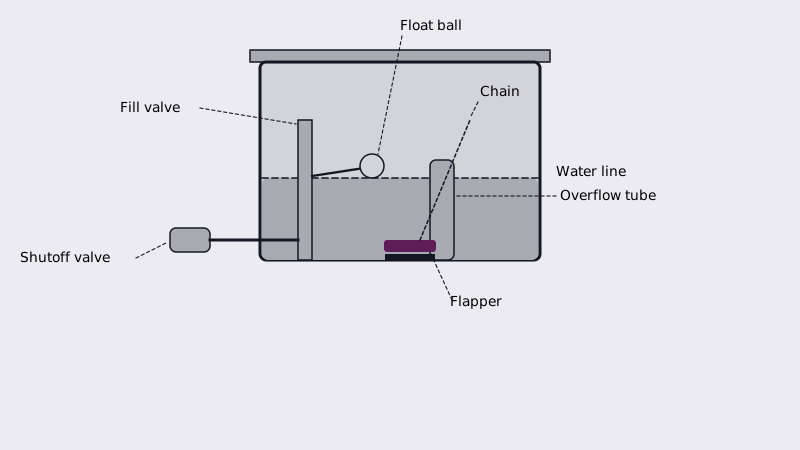
Three parts cause nearly every running toilet: the flapper that closes off the tank, the fill valve that tops it back up, and the float and chain that signal both when to stop. Pull off the tank lid and watch. The part still moving while the toilet should be silent is the culprit. This guide sits under toilet repair, where the other toilet jobs live.
Which part is making your toilet run?
Remove the lid and compare the water level with the overflow tube. If water spills down that tube, the float is set too high or the fill valve has failed. A normal level combined with a trickling bowl, or a tank that tops itself up now and then, points to a leaking flapper. Two minutes of looking beats guessing.
Put a few drops of dye in the tank water and wait ten minutes without flushing. If dye reaches the bowl, the flapper leaks; EPA uses this same test. Once done, flush so the tank does not stain.
Next, press the flapper down with a finger while the tank is full. A noise that stops tells you the cause. If a hiss carries on while the level stays well under the top of the overflow tube, the fill valve is failing to shut off.
Why does the tank keep refilling when nobody flushed?
A tank that refills with no one touching it, every ten or twenty minutes, has a slow leak past the flapper. The water level sags slightly, the fill valve notices and tops it off, and the cycle begins again. People call it a phantom flush. The water goes in small sips, so you only notice when the bill arrives.
Hard water speeds this up. Third-party estimates (waterhardness.org, 2023-2025 report years) put Murrieta tap water at roughly 6 to 11 grains per gallon, a moderate-to-hard range, though your own street may differ. Minerals build up on the flapper seat, and a rubber disc that sat in warm, mineral-laden water for years goes soft and warped. Rub the seat clean with a rag. If the flapper feels slimy or crumbles, replace it.
If the toilet kicks on randomly in the middle of the night, also consider high water pressure. A fill valve that weeps slightly can drift between closed and open as street pressure shifts over the day. Threading a gauge onto an outdoor hose bib answers that fast, and adjusting a pressure regulator explains which reading is healthy.
What does a flapper swap involve?
Start by shutting the wall valve, then flush to empty the tank. Lift the old flapper off the pegs on either side of the overflow tube and unhook its chain. Take it to the hardware store to match the size, usually 2 inch or 3 inch. Fit the new one, keep the chain slightly slack, reopen the water and flush to test.
Most do-it-yourself repairs go wrong at the chain. If it is tight, the flapper cannot seat; if it is loose, it tangles under the flapper. Aim for roughly a half inch of play with the flapper shut. Check the handle's lift arm too, because a bent arm can hold the chain up.
For a step-by-step picture of the parts, see toilet flapper repair. Rubber flappers harden and warp with age, so plan on swapping one every few years, whether or not it has failed yet.
What can you do when the fill valve keeps the water running?
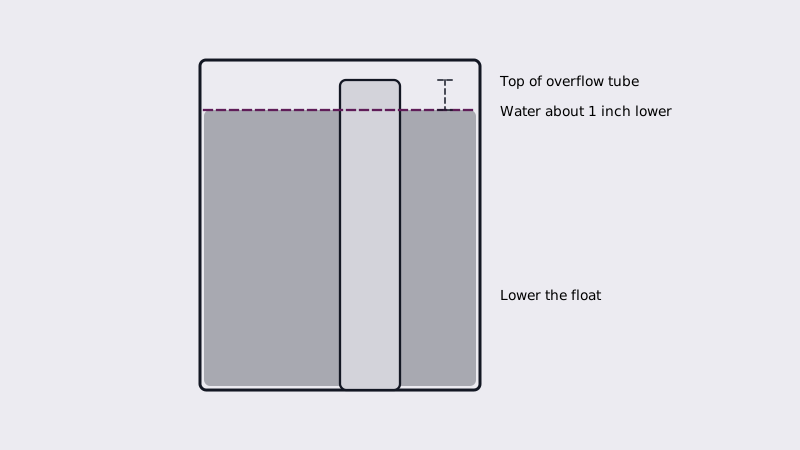
Adjust it first. Most fill valves have a float cup or a screw that sets the water height. Lower the float until the water stops roughly an inch under the rim of the overflow tube. If the toilet still runs, shut off the supply, take off the cap and flush out any grit. If that does not work, replace the whole valve.
A new fill valve is a small, inexpensive part and fits most toilets. You need a bucket, a sponge, an adjustable wrench and about thirty minutes. Hand-tighten the supply nut, then add a quarter turn. Over-tightening cracks the plastic tank hole. If the shutoff valve under the tank is corroded, stuck or drips when turned, it should be replaced first; read repairing a toilet shut-off valve.
For other parts, try swapping out a toilet fill valve and fixing a toilet stuck in a running cycle.
Why is water running in the bowl after you flush?
When the bowl keeps filling after a flush, the flapper may be closing late, the refill tube may sit too deep in the overflow pipe, or the tank may be overfilling. Make sure the small refill tube clips on above the water line; if it dips under, water can be drawn back into the bowl by siphoning.
Another cause is a cracked overflow tube, which lets water escape through the crack once the tank level rises past it. Run a fingernail down the tube to feel for a seam. Finding one means the toilet needs a complete flush valve assembly, which is more work than a flapper swap. When the flush itself is weak, see toilet flush repair.
What if the toilet rocks or water seeps around its base?
If the toilet rocks, the problem is at the floor, in the bolts or the wax ring seal, not in the running parts. Rocking can break the wax ring and let water seep beneath the base. Snug the closet bolts evenly, giving each a quarter turn per pass, and if the toilet still moves, it must be pulled and the ring replaced.
Wax ring trouble shows as water around the base only after flushing. Water that is there constantly points to the supply line or tank bolts instead. Do not caulk around the base and hope. A damp subfloor in a bathroom softens and the repair grows with it. Tile bathrooms on a concrete slab, common in Murrieta tract homes, hide it longer. A loose seat is its own job, covered in fixing a loose toilet seat.
Which signs mean a plumber should take over?
Make the call when the toilet keeps running after a new flapper and valve, when the shutoff valve will not close, when water appears at the base, or when the tank is cracked. A plumber is also useful for renters who cannot buy parts, or when several toilets run at once, which suggests a pressure or water-quality issue.
We pass your request to one local plumbing business. That business visits, writes the quote before starting, and pays us a fee for receiving the request. Mention the toilet's make and age if the date stamp inside the tank is legible. Past roughly twenty years, replacing may beat another repair, and a newer model uses less water per flush. Ask for a quote on the price request page. Other jobs we handle are on the home page.
Common questions
How much water is lost to a running toilet?
The amount depends on the seal. A silently leaking flapper can lose thousands of gallons yearly, and a constantly hissing toilet loses far more. EPA lists worn flappers among the leading causes of household leaks, with the typical home losing upwards of 9,300 gallons annually. A dye test costs pennies and settles the question.
Why does my toilet run only at night?
Night is when water pressure from the street tends to be highest and the house is quiet, so small leaks become audible. A flapper that seals under low pressure may seep at high pressure. Try the dye test in the evening and check the pressure with a gauge. If pressure reads high, the regulator may need attention.
Will a running toilet raise my water bill?
Yes, because every gallon going down the drain is billed. A running toilet is among the most frequent reasons for a sudden, unexplained jump. Check the meter while all fixtures are off. Movement means a leak somewhere, so close the toilet supply and check again. A stopped dial confirms the toilet.
Should you repair an old toilet or replace it?
Generally yes when the fault lies with the flapper or the fill valve, because those parts are cheap and standard. The case weakens when the porcelain has a crack, the toilet clogs often, or the model is very old and uses several gallons per flush. Ask the plumber to weigh repair against replacement when you get the quote.
Can I work on the toilet without turning the water off?
Small adjustments are fine live: you can move the float or chain and press the flapper to test it. Before replacing the flapper or valve, shut the valve behind the toilet. When that valve sticks or drips as you touch it, stop and get it replaced first.
References
Last changed