A softener in good order uses a small amount of extra water, since it flushes itself on a schedule, but it should not visibly dent the bill. A large jump normally signals a fault: a stuck valve that keeps draining, a clock that regenerates too often, or a leaking fitting. Check the drain line first. Equipment details are on our water softener installation page.
Does a water softener use enough water to move the bill?
Normally no. A softener regenerates now and then, flushing brine and rinse water down a drain line, which uses some water each cycle. Over a month that is a modest slice of household use. Anything beyond that usually points to a setting that fires too often or a valve that sticks.
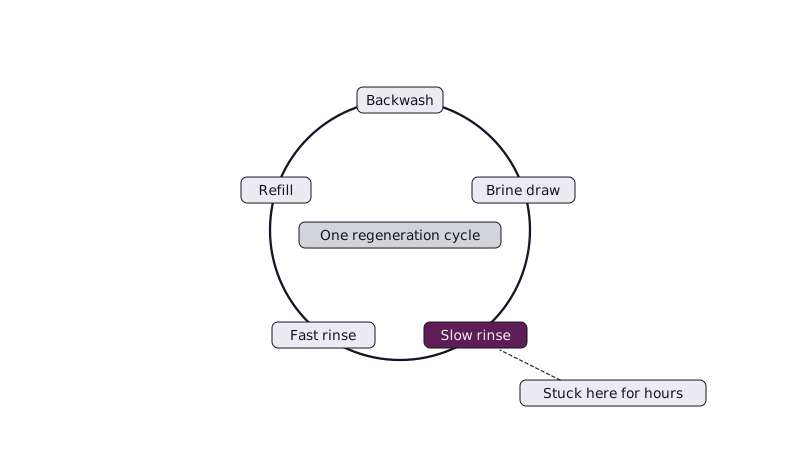
The cycle has stages: backwash, brine draw, slow rinse, fast rinse, refill. Regeneration is triggered either by a timer, which fires on set days no matter how much water you used, or by a meter that counts gallons. Timer units waste more when set too frequently. Meter-based units follow your actual use.
Your usage matters as well. Large families, and homes with higher hardness, regenerate more often. Third-party estimates from waterhardness.org (report years 2023 to 2025) rate Murrieta tap water as moderately hard to hard, roughly 6 to 11 grains per gallon, though your own address may differ. Check your district's yearly report, or use a test strip. That level of hardness is why many people fit softeners.
If your bill jumped the month the softener went in, ask whether the installer set the hardness figure and cycle correctly. A setting made for very hard water on a mildly hard supply wastes salt and water.
What faults make a softener run up the bill?
The classic fault is a drain that never stops. A worn seal, a stuck valve disc, a failed motor or a jammed timer can leave the unit stuck mid-cycle, sending water down the line around the clock. A leaking brine tank, a dripping bypass valve or a loose fitting cause smaller losses.
Walk through these:
- Listen at the unit. Hearing a trickle or rush in the drain line while no one is using water gives it away.
- Look at the cycle position. If the display or dial sits in backwash or rinse for hours, something is stuck.
- Look at the drain. Water in a standpipe, floor drain or utility sink, flowing at any time of day.
- Check the connections. Wet inlet and outlet fittings, a damp base or salt crust at joints.
- Check the bypass. A bypass left partly open does not waste water but keeps your supply hard.
Repair sometimes means replacing a seal kit or a control head, which a softener technician or a plumber can do. An aging unit with a failing head may be better replaced. Cost depends on the size and brand, and the plumber who visits quotes it.
Is the softener at fault, or is the water going elsewhere?
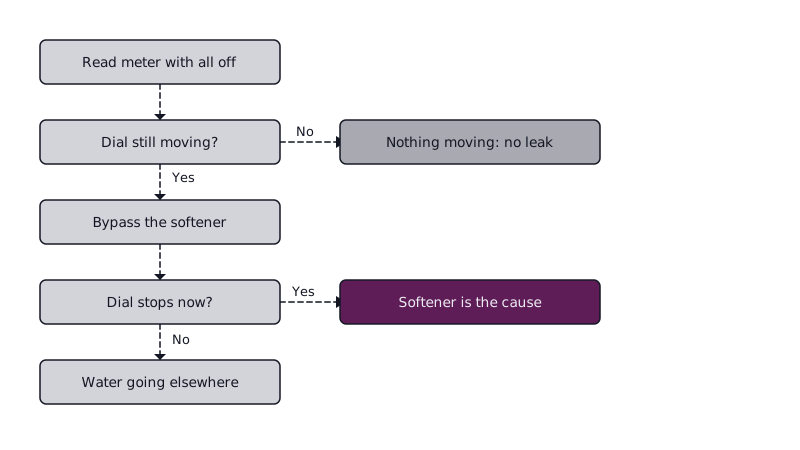
Run a meter test. Shut off all taps and appliances, then read the water meter or watch its low-flow indicator. If it moves, close the softener's bypass valve and look again. Movement that stops means the softener is the culprit. Movement that carries on means water is escaping elsewhere, for example via the sprinkler line, a pipe or a toilet.
Instructions:
- Make sure no one flushes, runs the dishwasher or starts the irrigation.
- Note the meter reading, wait fifteen minutes, read again.
- Put the softener in bypass and repeat.
- To catch a toilet leak, drip food coloring into the tank and watch the bowl. According to EPA WaterSense, leaks take upward of 9,300 gallons annually from a typical home, so these checks are worth your time.
The sprinklers are another common culprit in Murrieta's dry climate. A change in seasonal watering can push a bill up even when nothing is wrong with the plumbing. To look at bills more broadly, start with why a water bill goes up, then see a high bill when no leak shows.
At what point do I bring in a plumbing business?
Call when the meter test points to the softener and a simple reset does not fix it, when you find water at fittings you cannot tighten, or when the unit sits in a cycle for hours. Also call if it is leaking onto flooring. Leaving a faulty softener draining for weeks adds up.
A plumber can check the supply and drain connections, bypass, and the water pressure feeding the unit, which should be within the limits the maker lists. They can also tell you if the whole job was sized correctly. See leaks and burst pipes if the water is escaping elsewhere.
Some work is better done by the dealer or manufacturer of the unit, especially under warranty. Have the model and serial numbers on hand.
What can I do right now to cut the waste?
Close the softener's bypass to stop water flowing through it, or unplug a stuck unit if that is safe and the manual allows it. Then look at the drain. Set the cycle to a sensible frequency, with the hardness level matching your own measurement. Do this in a day and check again at the next bill.
The bypass trade-off is that your whole house gets hard water until it is fixed. Heaters and fixtures collect scale as time passes, so avoid leaving it that way for months. If the bill does not drop after a cycle or two, the cause is elsewhere. To get a local plumber, use the quote page. Requests go to local plumbing businesses, which pay us a fee, and whichever one visits quotes your price. The Murrieta Creek Plumbing home page shows other jobs.
Common questions
Does a salt-free conditioner change my water bill?
Usually not. A salt-free conditioner never regenerates, so it runs no drain cycles. They also do not remove hardness minerals the way a softener does. They change how scale forms. If a conditioner seems to coincide with a high bill, look for a leak at its fittings or elsewhere.
How often should a softener regenerate?
It varies with water hardness, household size and tank capacity. Meter-based units decide for themselves. Timer units run on fixed days, so choose a schedule that matches how much water you really use. If yours fires daily with two people at home, the setting is probably too aggressive.
Will my district water report help?
Yes. Your water district publishes a yearly consumer confidence report listing which minerals are present in the supply. It tells you roughly how hard your water is, so you can set the unit properly. Murrieta has a few districts, so look at your bill to see which one serves you.
Could a softener cause low water pressure instead?
Yes, a clogged resin tank or a half-closed bypass can restrict flow, so showers feel weaker. That is a pressure problem rather than a billing one. Measure pressure using a hose bib gauge, then bypass the unit to see whether flow returns.
Last changed