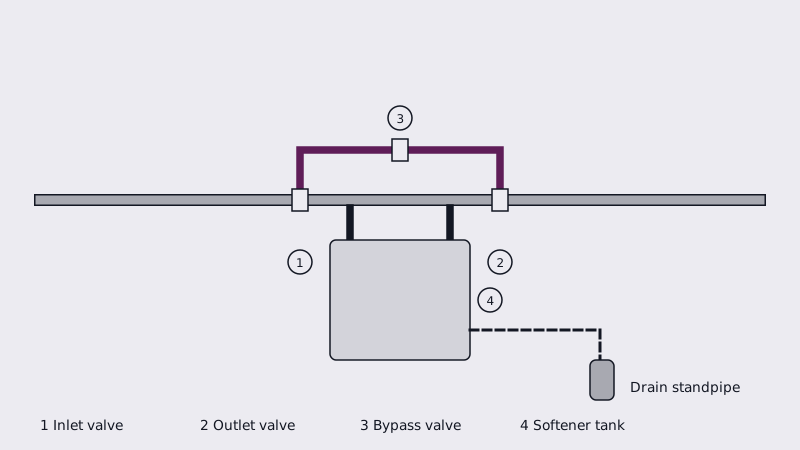
An installation service connects a softener to your main water line, sets up a bypass, runs a drain and an overflow line, programs the valve and tests it. The unit can be a brand you bought or one the business supplies. For the plumbing-trade overview, read about having a plumber install a softener; this page is about the service itself.
What happens during a softener installation visit?
First the installer chooses a location near the main supply and a drain, shuts off the water, cuts into the pipe and fits the softener with a three-valve bypass. A drain hose then goes to a floor drain or standpipe through an air gap. After that come the overflow line, a power outlet and the control settings. Finally the system is flushed and tested.
A typical sequence:
- Test the incoming water hardness and note household size, to set the regeneration cycle.
- Mount the unit level with room to add salt and service it.
- Connect inlet, outlet and bypass, usually with flexible connectors or new pipe.
- Run the drain line, leaving an air gap, plus a separate overflow line.
- Add salt, program the valve, flush, and check for leaks.
Have the installer show you the bypass valve and how to add salt before they leave.
What should I ask a water softener installer?
Ask what size unit they recommend and why, whether they test hardness first, what is included (bypass, air gap, drain, permit, haul-away of packaging), who will service the unit afterward, and what the maker's own warranty covers. Get a written quote that names the model. Treat any business that skips the hardness test with suspicion.
Ask for quotes through the price request form. We hand your request to local plumbing businesses, which pay us a fee for it, and each gives its own quote. The plumber, not us, does the installation. The home page shows the rest of the services we pass on.
Is a whole-house softener worth it in Murrieta?
If you are tired of scale on fixtures and glass, it can be. Third-party estimates call Murrieta tap water moderately hard to hard, roughly 6 to 11 grains per gallon, but your address may differ, so look at the report from your water district or test a sample. A softener fits best when hardness is clearly high.
Running costs count as well: salt, water used in regeneration, and service. No dollar figures are printed without a local source; see softener installation cost and whole-house softener cost for what drives a quote. A softener should not raise your bill much, but see can a softener affect a high water bill. For cleaning off scale already there, see removing hard water scale.
How does a softener installation work with well water or septic?
Wells and septic systems add steps. Well water should be tested first, because iron, sulfur or sediment can foul a softener and may need pretreatment. With septic, the maker's guidance and local rules decide whether regeneration wastewater can go to the tank. Ask the installer to plan both before buying the unit.
This is common in rural spots around Fallbrook, Rainbow, De Luz, Winchester and the Santa Rosa Plateau edge, where wells and septic are used on some lots. San Diego County rather than Riverside County covers the Fallbrook side, and permit rules differ. Which water district serves a given address varies by street; check which one bills you, or if the property relies on a private well.
What does the drain air gap do?
An air gap is a deliberate open space between the softener's drain hose and the drain, so wastewater can never be drawn back up into the softener or your drinking water. It is a basic safeguard, and the drain line should end above the standpipe or inside a fitting made for it, not sealed into the drain.
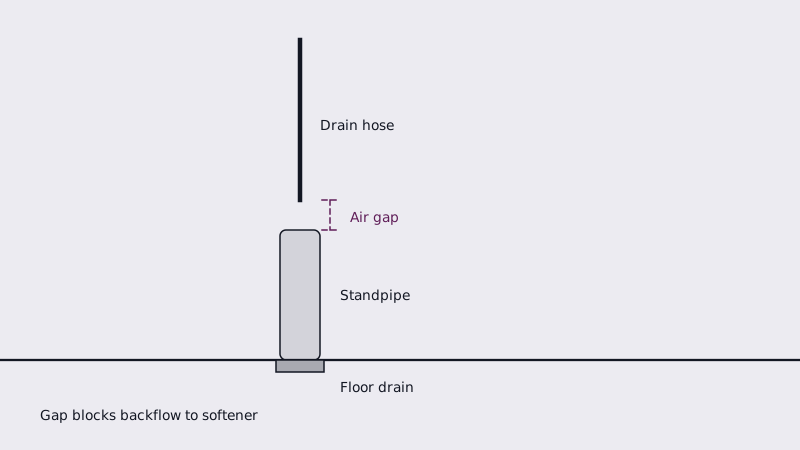
Manuals from the unit's maker specify the layout, and local code may add requirements. If you are working from an installation manual for a Whirlpool, Rheem or other brand, follow its drain and overflow instructions and check them against what the local office says. Keep the manual for later service.
Is a contractor required, or can I do it myself?
Many owners manage a basic install, but California rules generally call for a contractor license when labor and materials total $1,000, and for every job with a permit. Cutting into the main supply and tying into drains is plumbing work. Ask your city building office about a permit before you start.
If the work is done under a permit, an inspector may check it. For Murrieta addresses that is the City of Murrieta Building and Safety Division; for Wildomar, the Building and Safety office of the city; for unincorporated areas, Riverside County. Our guide on installing a water softener walks through the steps, but a plumber saves time and risk.
Common questions
How long does an installation take?
A straightforward install often takes a plumber just a few hours, although a time cannot be promised. Rural, well or septic setups, tight spaces or pipework that needs updating can take longer. The installer can give you a better estimate after seeing the site.
Can a softener go outdoors?
Some models are rated for outdoor use, with shelter from sun and freezing, but most go in a garage or utility closet. Check the manual, and ask about sun, summer heat, frost on cold nights, and where the drain and overflow lines can run before you choose the spot.
Is soft water safe to drink?
Softened water carries added sodium or potassium, depending on the salt used. Anyone on a diet that limits sodium should ask a doctor, and some households keep one tap unsoftened for drinking. This is a health question outside our scope, and we do not give medical advice.
Who services the unit afterward?
The installer, the maker's own service network or another local plumber, depending on the brand and how the unit was bought. Ask who handles service before you buy, and keep the manual, the receipt and the installer's contact details together in one place.
Last changed