A business with a backflow preventer installed on its water line is expected by the water supplier to have it tested, usually once a year, by a tester the supplier accepts, with the result sent in. Tests do two jobs: they prove the device still blocks reverse flow, and they keep your account in good standing. For other commercial jobs see commercial plumbing on short notice.
What does commercial backflow testing involve?
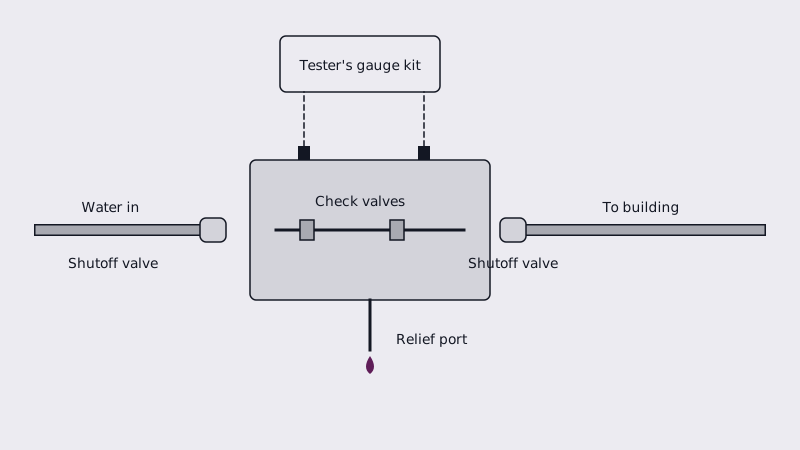
A tester connects a calibrated gauge kit to the device, shuts its shutoff valves in sequence, and reads pressure drops across its check valves and relief port. Each reading is compared with a pass value. The device passes, or it needs a repair and a second test. The tester then fills in a report for your water supplier.
Expect the water to the building, or the line the device protects, to be off for the test. For a small assembly that is ten to thirty minutes. A big fire-line assembly takes longer and may need advance notice for the fire alarm company. A restaurant should plan around the lunch rush, and a dental office around the next patient.
Bring the device's location, its size and its serial or tag number. If the supplier mailed a test notice, bring that too, because it normally names the deadline and where to send the paperwork.
Why does a business need it, and who sets the rule?
State rules for protecting drinking water from cross-connections sit in Title 17 of the California Code of Regulations, and each water supplier runs the program on its own system. Where a hazard exists, such as irrigation, boilers, chemical use or a fire line, the supplier requires an assembly and a test at installation and then on a recurring basis.
Backflow is simple physics. If pressure in the supply drops, for example during a main break or heavy firefighting draw, water can be pulled backward from a sprinkler head, a mop sink hose or a boiler into the public system. The device is the one-way gate. A stuck check valve or a torn seal makes the gate leak without anyone noticing.
Who your supplier is depends on the address. Eastern Municipal Water District is the most common supplier for Murrieta businesses, though some parts of the city are supplied by the Murrieta division of Western Municipal Water District or by Rancho California Water District. Wildomar is usually served by Elsinore Valley Municipal Water District, and Canyon Lake mostly by that district too, with a few homes on EMWD. The water bill names the right one, and its cross-connection office will confirm the test schedule.
Which devices are tested?
The common types are the reduced pressure principle assembly (often called an RP), the double check valve assembly, the pressure vacuum breaker used on irrigation, and the atmospheric vacuum breaker. RP and double check assemblies are the main commercial ones. The higher the hazard behind the device, the stricter the type the supplier asks for.
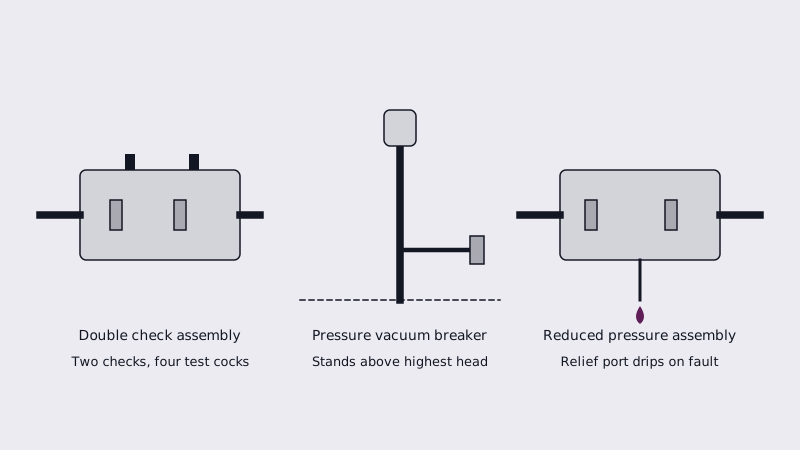
Some quick pointers on identification:
- An RP assembly has a relief port at the bottom that drips when something fails. It sits above ground in a cage in most cases.
- A double check assembly has two checks and four test cocks in a row, and may be in a vault.
- A pressure vacuum breaker stands on a pipe above the highest sprinkler head.
- Fire sprinkler systems often have a detector check or a double check at the riser; confirm who handles that with your fire alarm contractor.
Do not move a device, cap its relief port or bury it to hide it. That can fail an inspection and, more seriously, remove the protection.
What follows a failed backflow test?
A failed test means a part is worn, fouled or damaged. The plumber replaces the check or relief parts, flushes debris if needed, and re-tests, and the tester files both results. Suppliers usually set a deadline to correct it. If the assembly cannot be repaired, the plumber gives a quote for replacement, and a permit from the city or the county may be required.
Murrieta businesses obtain permits from the City of Murrieta's Building and Safety Division, 951-461-6062 (per the city page; confirm before calling). Winchester and French Valley sit under Riverside County. An overdue device draws follow-up notices from the supplier, so do not let one sit in a drawer.
What else does a commercial plumber handle beyond testing?
A commercial plumber covers more than backflow work: grease interceptors and traps in restaurants, restroom fixture batteries, tank-type and tankless heaters for large loads, gas lines to kitchen equipment, drain mains and roof drains, and repair of leaks in slab or ceiling. Commercial jobs also tend to involve permits, plans and coordination with a landlord or property manager.
For a tenant, who pays is a lease matter. A landlord may own the backflow device and the tenant may owe the test, or the other way round. Check the lease and ask the property manager first, before ordering.
How that work is billed is explained under commercial plumber hourly cost, while backflow testing for general customers covers the same topic from the household side. For the how-to steps in detail, read how backflow testing is done.
To arrange a test, send the quote request with your business type, the kind of device if known, and the date printed on the supplier's notice.
Common questions
How often does a backflow assembly need testing?
Usually every year, plus at first installation and following any relocation or repair. Your water supplier sets the exact schedule and often mails a notice with a deadline. If you cannot find the notice, call the supplier's cross-connection office and give the service address.
Can the plumber test it and file the report for me?
The tester files with your water supplier on its required form, often online. Confirm that the tester is on the supplier's approved list before booking, since reports from someone outside the list can be rejected. Keep a copy of every passed report in your records.
Can I test a backflow device myself?
No. Testing needs a calibrated gauge kit and a tester the water supplier accepts, and a self-test report will not be accepted. What you can do is keep the device clear of weeds, mud and storage, and keep the area around it accessible for the tester.
Do residential irrigation systems need it too?
Many suppliers require a backflow device on home sprinkler systems, and some ask for annual testing there as well. The rules differ by supplier, so check with yours. Our backflow prevention testing page gives the household side of the question.
What if the device leaks from the relief port?
Some dripping from an RP assembly can mean a fouled check or a pressure spike. Constant discharge is a fault. Do not plug the port. Shut the supply valves only if flooding starts, then call a plumber. Repair comes first, then a new test to confirm it passes.
More services are listed on Murrieta plumber.
References
- California Code of Regulations Title 17, cross-connection control (sections 7583 to 7605)
- Eastern Municipal Water District, who we are
Last changed