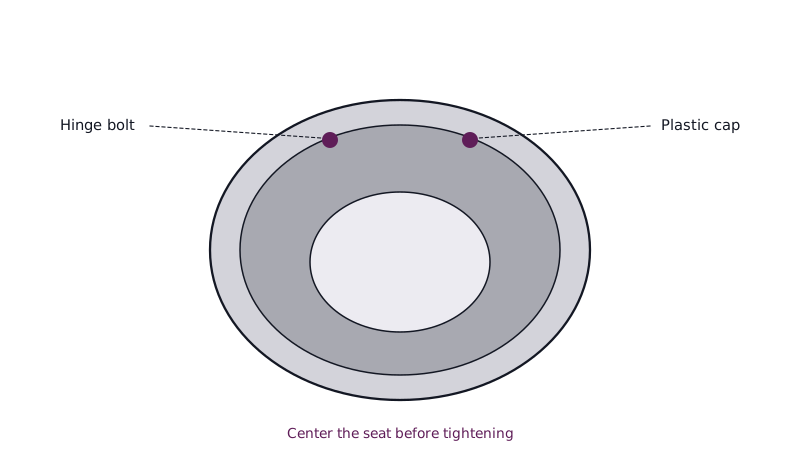
To fix a seat that wobbles, lift the plastic caps at the rear, tighten the bolts with a screwdriver while holding the nuts underneath with your fingers or a wrench, and make sure the seat is centered over the bowl. If the bolts spin freely, replace the nuts or the whole set. The other small fixes below fall under our toilet repair help.
How do you tighten a wobbly toilet seat?
Flip up the two small covers at the back hinge, grip the nut beneath the bowl, and turn the bolt head clockwise until the seat stops sliding. Square the seat on the bowl first, then snug it down. Do not overtighten, because the plastic can crack. A seat that still shifts needs a new bolt set.
If the nut underneath spins and you cannot reach it, a basin wrench or pliers will help. Hardware stores sell universal seat hardware, and some sets include rubber bushings that grip the bowl. Match the hinge style, since quick-release seats have a different mounting plate. If the bolts are rusted solid, a small hacksaw blade can cut them, and the whole set gets replaced.
Wipe the bowl rim and replace the bumpers while you have the seat off. A seat that loosens again within weeks usually has stripped plastic nuts or oversized bolt holes, which new hardware cures.
How do you replace a flush valve mechanism?
Close the water, drain the tank, disconnect the supply line, and lift the tank off the bowl when the valve is beneath it. Remove the old flush valve nut, set the new valve and its gasket in place, tighten the nut by hand plus a quarter turn, then reconnect and test. Replace the tank bolts and gaskets at the same time.
This job is larger than a flapper swap, since the tank often comes off the bowl. Have a helper for lifting, and keep a towel handy. Check the replacement valve's size, usually 2 or 3 inches, against the drain opening. Ask a trusted neighbor or friend to help lift the tank if it is heavy. A cracked tank or bowl calls for replacement rather than repair; see replacing a toilet for what shapes a quote.
When the water supply shutoff will not close or parts are corroded, call a plumber. Work that reaches $1,000 in labor and materials, or that needs a permit, generally goes to a contractor with a California contractor license; the CSLB site lets you check one.
What causes a slow flush, and how is it fixed?
Usual suspects for a slow flush are mineral scale in the rim jets, a partly blocked trap or drain, a tank that sits low, or a flapper that closes too early. Compare the tank water level to the fill line, clear the jets with vinegar and a wire, and try a plunger.
Third-party estimates generally rate Murrieta tap water moderately hard to hard, so scale in rim jets is a real possibility; check the district report or a test strip for your address. Pour a few cups of vinegar down the overflow tube and leave it to soak, then flush. If the bowl still drains slowly, plunge it. If several fixtures are slow together, suspect the drain rather than the toilet. For related repairs, see toilet flush repair and unclogging a blocked toilet.
What can be done when a flush button sticks or fails?
Lift the tank lid carefully and look at what the button moves. On a dual-flush toilet, the buttons press rods or a cable onto the flush valve. A stuck button usually means a misaligned rod, a bent linkage or a button that has come off its housing. Realign or reseat it and test.
Unscrew the button cap, lift the assembly out and look at the height: the rod should clear the valve without pressing on it all the time. If the flush valve is jammed open, the toilet runs and the button feels loose. Brands differ, so find the model on the tank or in the manual for the right replacement.
Begin by shutting the stop valve at the back of the toilet. Take photos of the parts so putting them back is simple. A button that works but the toilet only partly flushes suggests the valve is not lifting far enough, covered in the next sections.
How is a tank problem fixed, or a flapper replaced?
Close the water supply, flush the tank empty and inspect the flapper, chain, fill valve and overflow tube. A flapper that is warped, sticky or covered in grit will not seal, so the tank leaks into the bowl. Unhook it, fit a matching flapper, adjust the chain and refill.
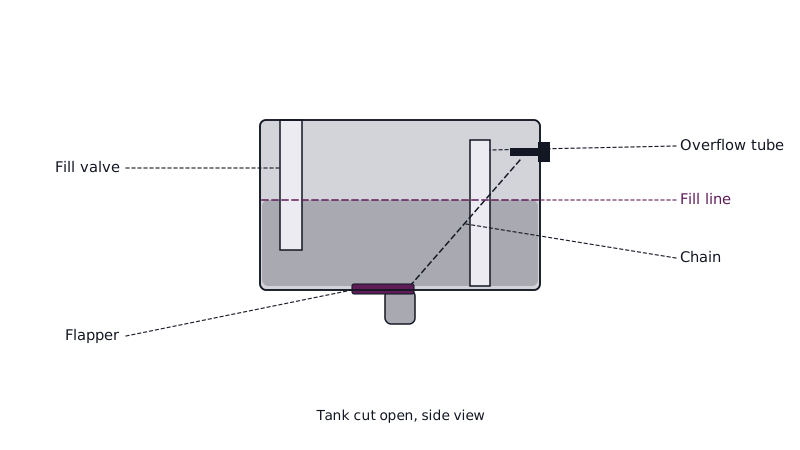
To test for a leaking flapper, stir food dye into the tank water, wait ten minutes and do not flush. Colored bowl water shows the seal is failing. Such a leak is silent and wasteful; EPA WaterSense puts an average household's yearly leak loss above 9,300 gallons of water. Our guides to fixing a flapper and to toilets that run constantly cover the details.
What if the repair is more than you can handle?
Tell us about the toilet, the symptom and what you have tried so far, and the request goes to one nearby plumber who can visit. Use the price request form or the number shown at the head of the page. Businesses taking requests pay us a fee, and each gives its own quote.
The same visit can include replacing the toilet or fixing the supply valve. The home page shows the areas we cover around Murrieta and Wildomar.
How is a toilet handle replaced, with or without a chain?
Close the water, lift off the lid, undo the handle nut inside the tank, which usually has a reverse thread, and draw the handle out. Install the new handle, set the lever arm, and link it to the flapper with the chain, or to the flush valve's own arm if there is no chain. Test the flush.
On many toilets a chain links the lever to the flapper. Some designs use a canister-style flush valve that lifts directly with a rigid arm or a clip and no chain at all. A chain that is too tight stops the flapper sealing, so the toilet runs, while a slack chain cannot raise it. Aim for just a little slack. For chainless valves, follow the instructions that came with the handle, as clips and arms vary by model.
Replace the whole handle if the finish is flaking or the lever arm is bent. Handle sets cost little and come in standard thread. Whether the handle mounts at the front, the side or the top of the tank is a question of fit, so confirm the position first.
Common questions
What makes a toilet seat work loose again and again?
The bolt holes in the seat or the plastic nuts can wear, so tightening only helps for a while. A bowl with a wide mounting gap may also let the seat slide. Swapping in a new bolt set with rubber or expanding bushings usually fixes it for good.
How tight should toilet seat bolts be?
Snug is enough. Turn until the seat stops moving, then stop. Plastic bolts and nuts strip or crack if forced, and the bowl itself is porcelain, which can chip around the holes. Check the seat is centered before the final turn, and retest after a week of use.
Why does a toilet handle wobble or fall off?
Maybe the nut on the inside of the tank has worked loose, or the lever arm may have come off the flush valve linkage. Tighten the nut, bearing in mind that its thread runs the opposite way, and check the chain. Replace the handle when the arm is cracked or the threads are stripped.
Is a slow-flushing toilet a sign of a bigger problem?
Sometimes. When just the toilet is slow, scale, a low water level or a partial clog is likely. If tubs and sinks drain slowly too, or you hear gurgling, the trouble may lie in the main drain. In that case, have a plumber inspect it.
Last changed