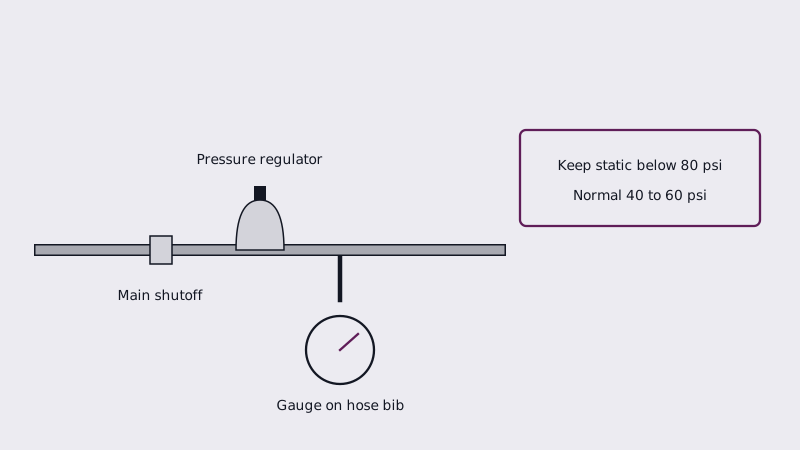
To adjust a pressure regulator, start with a gauge reading, then free the locknut on top of the bell-shaped valve and nudge the adjusting screw. Turning it clockwise generally increases pressure, and the other way decreases it. Look at the gauge again after every quarter turn. If low pressure brought you here, see how a plumber for low water pressure sorts out the real cause.
In most Murrieta and Wildomar homes that have one, the regulator is found where the supply pipe enters the building, close to the main shutoff. It is there because the utility delivers water at a higher pressure than fixtures and appliances can take, and without it a washing machine hose or a water heater connection can fail early. The steps below assume a standard single-family home on a city or district supply.
How can I tell the regulator is going bad?
Attach a hose-bib pressure gauge to an outdoor faucet with everything in the house off, and read the static pressure. Normal household pressure often falls between 40 and 60 psi. A reading above 80 psi, or a needle that creeps upward overnight, signals a failing regulator that lets full supply pressure through.
Other signs: banging pipes when a valve closes (see water hammer sounds), toilets that keep running once the tank is full, faucets that spit or hiss, and a water heater whose relief valve drips. Any hardware store sells a gauge cheaply, and it answers the question within a minute.
If the reading is already low, the regulator may be set too low or clogged with debris, or the trouble may lie elsewhere. Other causes are covered in our guide on why water pressure is low.
Where does a house keep its water pressure regulator?
Look just downstream of the shutoff valve on the main line. That is typically where the pipe enters the house or garage, in a utility closet, by the water heater, or inside a buried box in the front yard. The part resembles a small bronze bell topped by a screw and nut. Not every home has one.
Check near the hose bib closest to the street, in the garage wall and beside the water heater. In many tract homes the regulator sits in the garage or a side-yard box. If you spot a bell-shaped valve on a three-quarter-inch line, that is probably it; our page on where the regulator is located shows more spots.
If you cannot find one, your supplier may deliver at a pressure low enough that none was installed, or an earlier owner removed it. Do not assume; test with the gauge.
Can a homeowner adjust the regulator personally?
Yes, tuning an existing regulator is a common homeowner task, provided you own a gauge and go slowly. Replacing it can be different: depending on the work, a permit may apply, and gas or main-line work has its own rules. Before cutting any pipe, check with your city or county office.
Here is the sequence:
- Attach the gauge to an outside faucet and note the reading with all water off.
- Open a hose bib or a tub tap to bleed off pressure, then shut it again.
- Use a wrench to loosen the locknut on the adjusting screw by one turn.
- Give the screw a quarter turn, clockwise for more pressure, the opposite way for less.
- Close the tap, let the gauge settle, and repeat.
- Tighten the locknut when you reach the target, then test a few fixtures.
Aim for the middle of the normal range, not the top. The California Plumbing Code calls for a regulator whenever static pressure exceeds 80 psi, holding it at or below that limit, so never set it higher.
What happens inside a regulator, and why does it fail?
Inside are a spring-loaded diaphragm and a valve seat. Incoming water presses the diaphragm against the spring, and the tension you set with the screw determines how far the valve opens. A worn seat, or debris stuck in it, makes the regulator creep and pass full pressure, or close down too far.
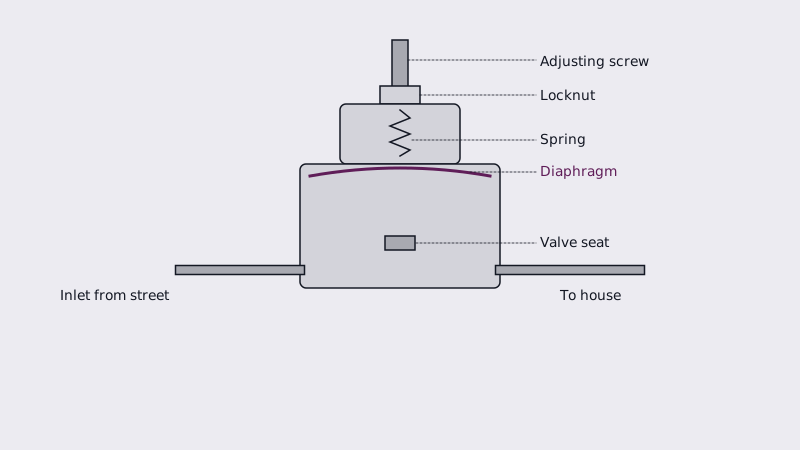
A decade or more is a common lifespan for a regulator, though it varies by brand and by how rough the water is. Water in Murrieta is usually called moderately hard to hard, and scale and sand can foul the seat. A regulator that ignores the screw, or leaks at the bell, needs replacing rather than tuning.
The brass 3/4-inch type is the common size; see our notes about the common three-quarter size and replacing a regulator.
What about shower head, hose or pump regulators?
None of those is the house regulator. A shower-head flow restrictor is a plastic insert that limits gallons per minute and can be removed or cleaned, but it does not control house pressure. A hose-end regulator protects a hose and sprinkler. A pump pressure switch regulates a well pump, which matters on rural lots that rely on a private well.
Washing machine regulators are rarer, and an inline valve there is a different part from the house regulator. If your complaint is one weak fixture, scale in the aerator or head is more likely than a regulator fault. Murrieta Creek Plumbing's pages on sudden low pressure help sort single-fixture and whole-house symptoms.
When should a plumber replace the regulator instead?
Call a plumber if turning the screw changes nothing on the gauge, the reading stays over 80 psi, the bell is leaking or corroded, or a swap would mean cutting the main line. A new regulator also needs a proper union fit and sometimes a bypass or an expansion tank.
Price depends on access, pipe size and whether a permit is needed. No dollar figure is printed here; regulator installation cost lists what moves a quote.
Whatever you send through the form goes to one local plumbing business, and such businesses pay us a fee for taking requests. That business writes you a quote and does the work; this site does not.
Common questions
Which direction raises the pressure on the adjusting screw?
On most standard regulators, clockwise raises it and counterclockwise lowers it. Each turn changes little, so move in quarter turns and check the gauge every time. Always loosen the locknut first and tighten it again at the end, or the setting will drift over time.
What pressure should the gauge show?
Many homes do well between 40 and 60 psi, though comfort and appliance needs differ. 80 psi is the limit set by the California Plumbing Code, and the EPA notes that high pressure can worsen leaks. A reading above 80 means the regulator or an upstream problem needs attention.
Will adjusting the valve fix low pressure in only one fixture?
No. A regulator controls the whole house. One weak shower or sink suggests scale in the aerator or head, a stop valve that is only partly open, or a clogged supply line. Clean the aerator first, then open the stop valve fully. If every fixture is weak, the regulator or the main is the likelier cause.
Does a bad regulator affect my water bill?
It can, indirectly. High pressure makes small leaks worse and strains hoses, and a leak left running adds up. EPA data say a typical home loses more than 9,300 gallons per year to leaks. Fixing pressure will not lower a bill by itself, but it removes one reason for leaks to start.
Is a permit required when swapping the regulator?
The answer depends on the scope and on where you live. Inside Murrieta, the City Building and Safety Division can tell you; in unincorporated areas such as French Valley, Riverside County handles permits. Adjusting a screw needs none, but cutting into the supply line may, so ask before you start.
For the wider picture, start with plumber across Murrieta.
Last changed