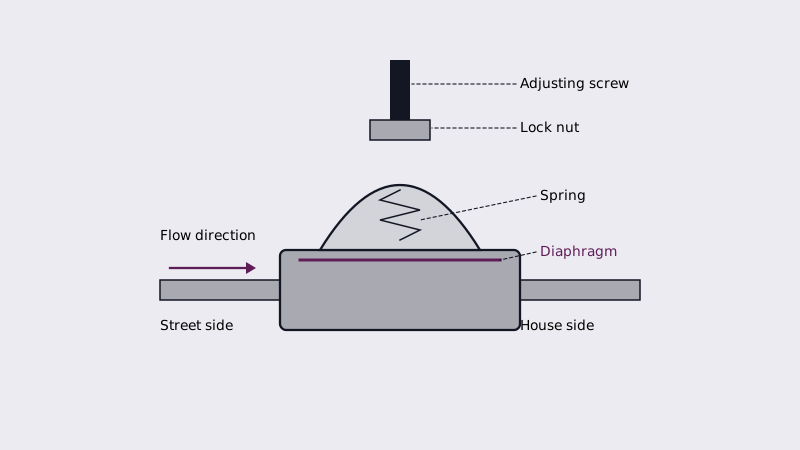
A water pressure regulator is a bell-shaped valve near where the supply enters the house that holds pressure to a safe level. Replace it when a gauge shows pressure above 80 psi, when pressure creeps up, or when taps bang and fixtures wear fast. It belongs to our water pressure and valves guides.
How do you know a pressure regulator needs replacing?
Look for water pressure that is too strong or swings during the day, banging pipes, a water heater relief valve that drips, toilets that run on their own, short-lived faucets and hoses, and a gauge that reads over 80 psi. A regulator can also fail low, leaving weak pressure at every fixture.
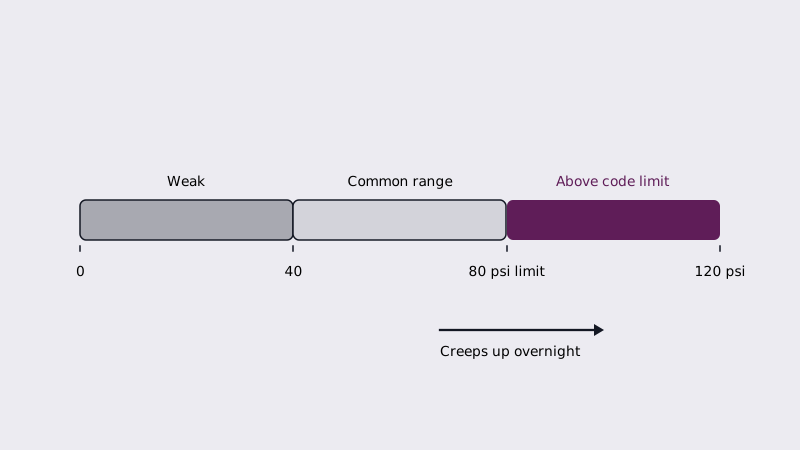
Testing is simple. Thread a pressure gauge on to a laundry tap or an outdoor hose bib, check that no other water is running, and read the dial. California Plumbing Code section 608.2 sets 80 psi as the threshold above which a regulator is required. Keep an eye on the gauge for several hours, since pressure can creep up overnight when demand is low.
If the pressure is normal in the daytime and high at night, the regulator may be failing, because it lets supply pressure through while the house is quiet. A pressure that stays low at all times may point to a clogged strainer or a partly closed valve rather than a regulator, so test before buying anything.
Where is the pressure regulator, and what does it look like?
Most are installed on the main supply line immediately after the shutoff valve. Typical places include the spot beside the front hose bib, a street-facing garage or utility wall, or a buried box close to the meter. It looks like a brass bell with an adjusting screw and lock nut on top. Some homes have none.
Not every home has a regulator, and some districts supply water at moderate pressure already. If you cannot find one, a plumber can tell you if the line has one, and where it sits. Our page on where a regulator is located shows common positions, and the guide on adjusting the regulator valve explains the screw.
Sizes differ, with a 3/4 inch valve common for houses, and there is a page on 3/4 inch regulator valves. Take a photo of the label or the size markings before shopping.
Should you adjust or replace the regulator?
If the gauge reads high but the valve otherwise works, adjust it: undo the lock nut, turn the screw by small amounts and read the gauge after each one. Replace it when turning has no effect, pressure creeps back, the valve leaks, or age and corrosion have taken hold. A new unit is more dependable than repeated tinkering.
Make small adjustments, roughly a quarter turn, then open a tap to settle the reading. Many homes run happily in a moderate range, and the manufacturer lists the target for each model. Do not push the setting far beyond what the manual suggests. If an adjustment lasts only a day or two, the diaphragm inside is probably worn.
A regulator has a life span, but we state none because water quality and pressure change it. Hard water and sediment shorten it. Third-party estimates generally rate Murrieta tap water moderately hard to hard, and the strainer inside the valve can clog; check your district report or a test strip for your address.
What does a regulator replacement involve?
First the plumber shuts the main and relieves the pressure. The old valve is then cut out or unscrewed, a matching new one goes in with unions or fittings, and it is set to the right pressure. Last, the water comes back on and the plumber tests for leaks and hammer. It is usually quicker than a water heater swap.
Details change the work. A valve on a threaded line may swap with wrenches, a soldered copper line may need cutting and new fittings, and an old line may be corroded enough to need extra repair. Plumbers often add or replace a thermal expansion tank near the water heater, because a regulator can make the system closed; that case often needs an expansion tank, though code does not say so in every situation. See the water heater pressure regulator page and expansion tank replacement.
Ask whether the job needs a permit. Within Murrieta city limits, the Building and Safety Division answers on 951-461-6062. County areas such as French Valley and Winchester come under Riverside County. In California a contractor license is generally needed when labor and materials total $1,000 or more, or when a permit applies; you can verify a license on the CSLB website.
Can you replace a pressure regulator yourself?
Possible, as long as you can confidently shut the main, working with pipe and testing for leaks, and the job needs no permit. Many people hire a plumber because a leak at the main fitting floods the house, and the main shutoff itself may be worn. If the main will not close, stop and call.
A straightforward swap goes like this: shut the main, open a low tap to relieve pressure, note the flow arrow on the old valve, remove it, fit the new valve facing the same direction, then set the pressure by gauge. Use proper thread sealant or tape, and tighten the nut with a wrench, not by hand. After turning water on, check each joint for several minutes.
Where gas, a permit or a main-line repair is involved, leave it to a contractor who holds the right license. Never guess at a leak near a gas line. If you smell gas, exit the house first, then call SoCalGas at 1-800-427-2200 from somewhere safe outside, and ring 911 should anyone be at risk.
What should a regulator replacement quote include?
A written quote should name the valve make and size, the pressure it will be set to, any fittings or unions, expansion tank work, permit if needed, labor and the plumber's warranty. We state no price here because none has been confirmed. Compare at least two quotes, line by line.
Our page on regulator installation cost explains what moves a price. Fill in the price request form and we pass it on to a nearby plumbing company able to visit you. Such businesses pay us a fee for requests they take, and each one gives its own quote. The home page lists where we cover.
Common questions
How much time does a regulator swap need?
For a simple swap on accessible pipe it often takes part of a morning. Corroded lines, a buried valve box or extra expansion tank work add time. The water stays off during the swap, so ask when it will be back on and plan around that.
What pressure should I set the regulator to?
Many homes run comfortably in a moderate range, but the right figure depends on the home, fixtures and the manufacturer's guidance. The code sets a ceiling of 80 psi, and many plumbers set well under that. Check your appliance and fixture manuals, and ask the plumber what they will use and why.
Could a faulty regulator lead to weak pressure?
Yes. A clogged strainer or a worn diaphragm can restrict flow, leaving all fixtures weak. Check pressure with a gauge before assuming it is the regulator. A half-shut valve, a leak or a clogged pipe can also be responsible, as our low water pressure guide explains.
Will replacing the regulator stop banging pipes?
Maybe. If high pressure is the cause, a new regulator often calms water hammer. If hammer comes from loose pipes or quick-closing valves, pressure alone will not fix it, and a plumber may add arrestors or secure the pipe. See water hammer sound.
References
- California Plumbing Code, section 608.2 water pressure limit
- California Contractors State License Board
- City of Murrieta Building and Safety Division
Last changed