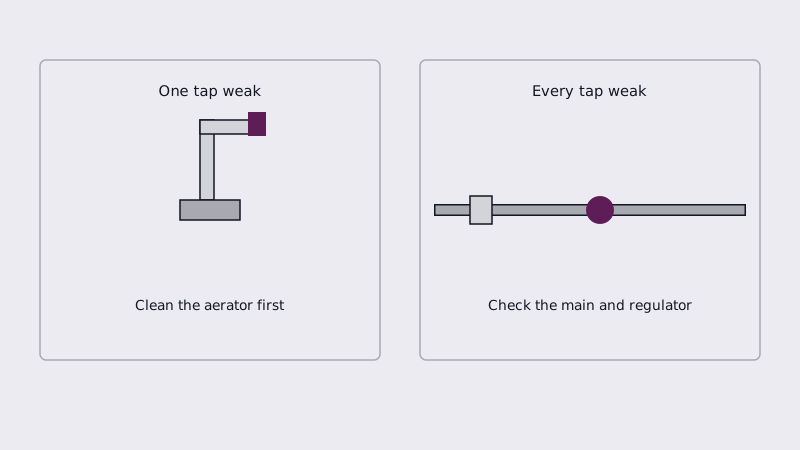
Start with the scope. When just one faucet or shower is weak, the cause sits at that fixture, often a clogged aerator or cartridge. When every tap in the house is weak, check the shutoff valve, the pressure regulator, scale in old pipe, a hidden leak or the supply itself. The page for a low water pressure plumber covers getting help.
Is the weakness at one fixture or throughout the house?
Run a cold tap at the kitchen, a bathroom sink and a shower. Weak at one point means a clogged aerator, showerhead or valve cartridge. Weak everywhere means the cause lies upstream: the main valve, the pressure regulator or the supply line. When only hot water is weak, the heater or its shutoff is the likely culprit.
This one test saves a lot of guessing. Unscrew the aerator from the faucet and rinse it; if the flow jumps, you are done. Check the showerhead for white crust. For kitchen and shower specifics, see the kitchen sink guide and the shower guide.
Why do I need a water pressure regulator?
Street water often arrives at pressure higher than fixtures and appliances are built for. A regulator trims it to a safe level for the house. The California Plumbing Code puts the ceiling at 80 psi, and a regulator holds pressure below it, protecting supply lines, the water heater, valves and washing machine hoses from strain.
So a regulator is not a cause of weak flow when healthy, but a stuck or worn one can strangle pressure or fail open and let it spike. Replacing one is a plumbing job, and you can see how to adjust the valve and replacing the regulator for what the plumber does.
How can I check the pressure in my house?
Thread a gauge onto an outdoor hose bib, confirm that no tap or appliance is running, and read the dial. Many sources describe roughly 40 to 60 psi as comfortable for a home, with anything over 80 psi above the code limit. These gauges are cheap at hardware stores. Take the reading at a quiet time of day.
A reading above 80 means the regulator should be looked at, and a very low reading at the hose bib, with a good main valve, suggests the supply or a blockage. Write the number down and give it to the plumber; it shortens the visit.
Does the sudden kind need different handling?
Yes. A drop that happened overnight suggests a closed valve, a break, a utility problem or a failed regulator. Check whether neighbors are affected, look for water in places it does not belong, and see sudden low water pressure. Ask the water district whether work is under way in your area.
Could hard water scale be the cause?
Yes. In an area with hard water, mineral scale builds up in aerators, showerheads, water heater fittings and old pipe, and slowly reduces flow. Reduction is gradual, over months or years. Third-party estimates generally rate Murrieta tap water moderately hard to hard, but your address may differ, so check your district's water quality report.
Soaking an aerator in vinegar clears light scale. For the whole house, a softener or scale prevention may be an option, as discussed in hard water scale prevention. Which district supplies you can vary by street, so check which one bills you.
Is weak pressure a danger?
Weak pressure itself is rarely a safety risk, but it can signal a leak, a failing supply line, or a problem that leaves a tankless heater short of flow. Dishwashers and washing machines may fill slowly or fail to rinse. If pressure drops suddenly and you also see damp patches or a climbing bill, get it checked soon.
On the other side, high pressure is the one that causes damage: burst hoses, leaking fixtures and shortened appliance life. If the number is over 80 psi, treat that as the problem to fix.
Why would the whole house have weak pressure?
The main causes are a partly closed shutoff, a failing pressure regulator, mineral scale or corrosion choking old pipe, a hidden leak, a blocked filter or softener bypass, or a drop in the supply from the utility. Which one it is can often be told by timing: sudden changes point to a valve or a leak, slow declines to scale.
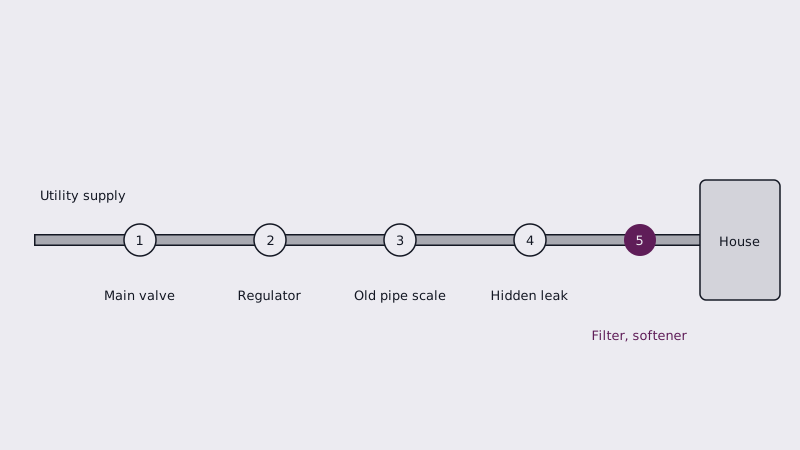
Look at these in order:
- The main valve. Turn the whole-house valve fully open. A half-open valve after a repair is a classic, free fix.
- The regulator. A bell-shaped valve close to where the supply pipe comes into the house. A failing one can let pressure fall, or spike. Read locating the regulator.
- Old pipe. Galvanized steel narrows with rust and scale; read about galvanized pipe replacement.
- A leak. Water escaping before it reaches your tap lowers pressure. Check the meter reading with all fixtures shut.
- A filter or softener. A clogged cartridge starves the house. Try the bypass.
- The supply. A break in the main, or maintenance on the utility's lines, can drop pressure for a neighborhood.
Common questions
Can I raise the pressure myself?
If your house has a regulator, it can often be adjusted, but only with a gauge and care, as too high is worse than too low. Working on the regulator is plumbing work, and many owners leave it to a plumber.
What will fixing it cost?
It depends on the cause: clearing an aerator costs nothing, while a regulator or a section of pipe is a plumber's job. We do not print figures we have not verified. Get a written quote, and see pressure regulator installation cost.
Why is pressure low only in the morning or evening?
Demand across your area can lower pressure at peak times, such as early morning when everyone showers or summer evenings with sprinklers running. If the dip is regular, call the water provider named on your bill and ask whether they know of a supply issue.
Should I call the water district first?
Yes, when neighbors share the problem, since the cause may lie at the water district's end of the meter. Otherwise start with your own valve and regulator. If you cannot find the cause after that, request a plumber through the quote form.
This guide is one of many on Murrieta Creek Plumbing plumber.
References
Last changed