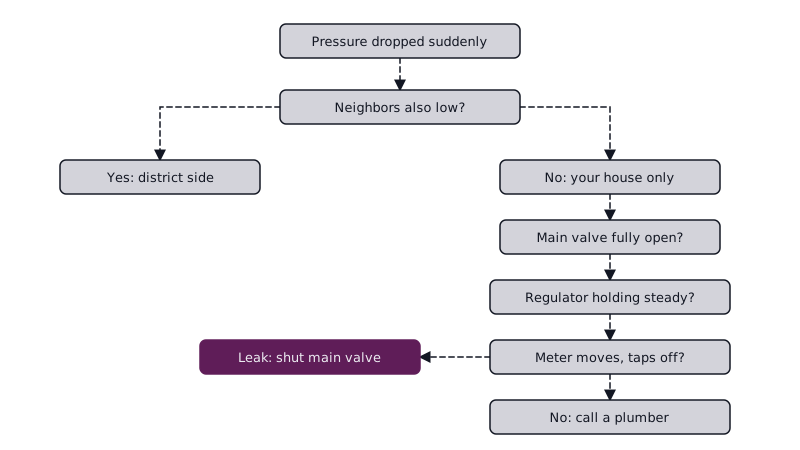
Start by asking whether the weak flow hits a single tap or every outlet, hot and cold or only hot, and whether the neighbors are seeing the same thing. A sudden whole-house drop usually means the supply changed, the main valve or pressure regulator failed, or a leak is draining the line. Pressure that fades gradually across several months is another matter, handled on the hub page about pressure and valve problems.
What are the most likely causes when pressure drops suddenly?
Five causes cover most cases: work or a break on the district's main, a partly closed main shutoff or meter valve, a regulator that has failed, a leak in the supply pipe between meter and home, and a clogged filter or aerator. Check them in that order, cheapest first, since the first two cost nothing.
A short symptom guide:
| What you see | Likely cause |
|---|---|
| Every tap weak, neighbors too | District work or a main break |
| Every tap weak, only your house | Main valve, regulator, or a hidden leak |
| Only hot water weak | Water heater valve or sediment |
| Only one tap weak | Aerator, cartridge or stop valve |
| Weak, and the meter dial spins | Leak in the supply pipe after the meter |
Pressure that is too weak after a repair visit often means a valve was not reopened fully.
What if the low pressure is only at the hot taps, or one fixture?
If just the hot taps run weak, look to the water heater first: a valve on it that is partly shut, sediment, or a dip tube on its way out. Weak flow at one tap is nearly always the aerator, cartridge or stop valve under it. These are separate problems from a whole-house drop and have simpler fixes.
Unscrew the aerator and rinse the screen. Third-party estimates rate Murrieta tap water as moderately hard to hard in general, so scale is a frequent culprit; check your district's report for your address. For fixtures see low pressure at a kitchen sink, low shower pressure and water heater pressure problems.
If you recently had a softener, filter or plumbing work done, check that bypass valves are in the right position and that filters are not clogged.
Is it the water district or your own plumbing?
Ask a neighbor and check your water district's outage page or phone line. Which district bills you matters: in Murrieta it is most often Eastern Municipal Water District (EMWD), with Western Water or Rancho California Water District serving some addresses, and Wildomar and Canyon Lake are usually on Elsinore Valley Municipal Water District, so check your bill.
If neighbors are affected, it is on the district's side: a main break, a maintenance shutoff or a reservoir problem. The district can tell you the cause. If only your house is low, the problem starts at your meter. Do not call the district about a fault inside your house; call a plumber.
EMWD and EVMWD both publish contact details for their customers. Canyon Lake's city page notes that you should call to verify which district serves your area, since a small part of the community is on a different one.
After a district shutoff, air and debris in the line can briefly cut flow. Open a hose bib or the lowest tap for a minute to flush the line, and clean the aerators.
At what point should you hire a plumber?
Book a visit when the meter keeps turning with everything off, the main valve is fully open yet pressure stays low, the gauge reads wrong, or the regulator needs replacing. A plumber tests at the meter side and at the house to pin down where the pressure is lost. Shut the main if water is escaping.
Send a quote request saying whether the problem is the whole house or one tap, what the gauge read and what you tried. We pass it to nearby plumbing businesses, which pay this site a fee for introductions, and whichever one responds prices and does the work. Your own water district deals with anything upstream of the meter. For other services, see the home page.
Could a hidden leak be causing the drop?
Yes. A leak in the buried supply pipe after the meter, or under a slab, lets water get away before it reaches the taps. Turn off every water-using fixture and appliance, read the meter or watch its low-flow indicator, and see whether it moves after fifteen minutes. A moving dial with everything off means water is leaking somewhere.
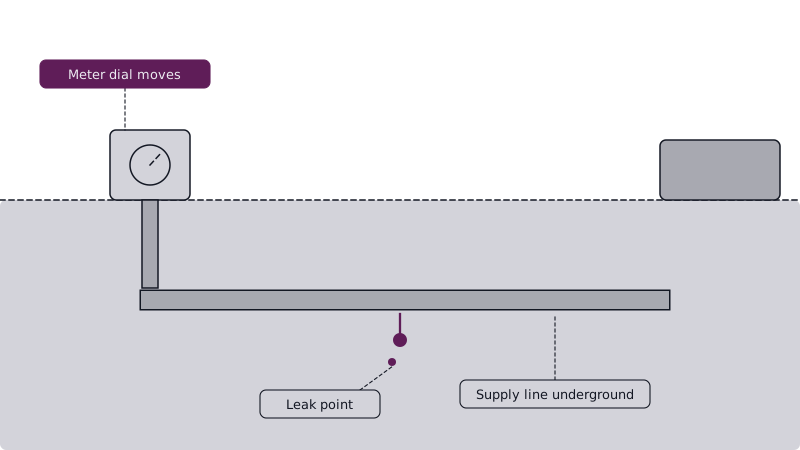
More warning signs include a soggy patch in the yard, a hissing sound near the line, warm spots on a slab floor, or a jump in your bill. Close the main valve if you find active water, and call a plumber. See signs of a burst pipe and a high bill but no leak you can see.
EPA figures show the average home losing over 9,300 gallons yearly to leaks, and a hidden main-line leak can lose a good deal more. That is one reason a sudden pressure change deserves a check the same day.
What should you check at the main valve and the regulator?
Find the main shutoff, usually on the street-facing side of the house or close to the meter. Its handle should be fully open, and a gate valve nudged by work or a bump may be only part open. Then look for the pressure regulator, a bell-shaped brass fitting near the main line that reduces the street pressure coming into the house.
Test with a pressure gauge, which screws onto a hose bib and is cheap at a hardware store. Under California's plumbing code the limit is 80 psi, and many homes run lower, so a reading well below what you had before points to a failing regulator or a restriction. A reading much higher than expected also needs attention.
A regulator that fails can drop pressure suddenly, or fail high and stress fixtures. Our pages show where the regulator sits, how to adjust it and when it needs replacing. Adjusting a regulator is possible for some owners, but replacing one involves cutting into the main line, which should be a contractor's job.
Common questions
How low is too low for water pressure?
Many homes run somewhere between 40 and 60 psi, while 80 psi is the upper limit under the plumbing code. Pressure well below what you are used to is a problem, whatever the number. Screw a gauge onto a hose bib and record the reading while no water is running.
Can a stuck regulator cause sudden low pressure?
Yes. A failed regulator can choke flow or fail the other way and spike pressure. A gauge reading after the regulator that is much lower or higher than before is the clue. Replacement is normally a plumber's task because the main line must be cut and rejoined.
Will the water district fix a problem in my house?
No. Its mains and the meter are the district's responsibility, while everything past the meter, such as your regulator, shutoff and pipes, is yours. Neighbors with the same drop should report it to the district. When your house alone is affected, the fault is on your property and you need a plumber.
Is sudden low pressure an emergency?
It can be. If the meter dial spins with everything off, or water shows up in the yard, assume a leak and shut the main. If neighbors are also low, it is likely the district and can wait. When unsure, check the meter first.
References
- General home plumbing practice and the California Plumbing Code 80 psi limit; no price figures on this page
Last changed