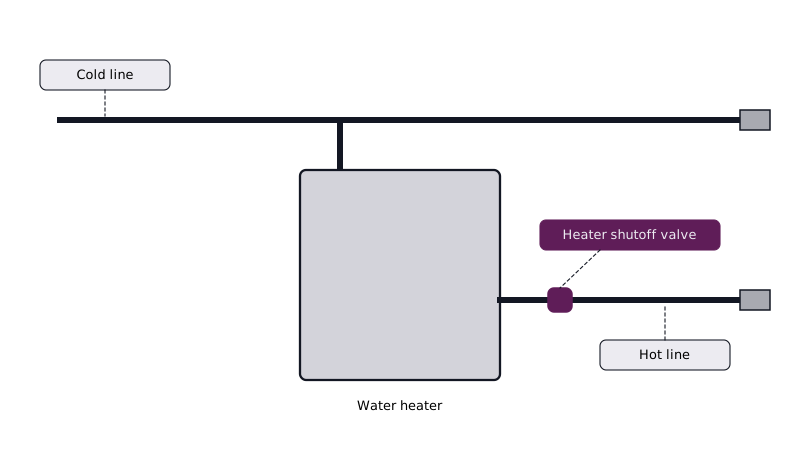
When pressure drops at the hot taps only, the cold side is fine, and the fault lies in the heater or its hot-water piping. The usual suspects are a valve at the heater that is only partly open, sediment, a clogged aerator or a corroded line. If hot and cold are both weak, look at the house supply instead. Our water heater repair page covers the equipment.
What makes pressure low on the hot side alone?
Something between the heater and the fixture is restricting flow. Compare one faucet on hot and on cold. Strong cold with dribbling hot means the restriction is on the hot side only. Common causes are a half-open shutoff, sediment clogging the outlet, scale in the fixture, or a worn mixing valve.
Work through it from least effort to most:
- Test several fixtures. One weak faucet means that faucet. Weak flow at every hot tap means the heater or main hot line.
- Unscrew the aerator at the faucet tip and rinse out grit. Hard water leaves chalky buildup that narrows the openings.
- Check the heater's shutoff valves. Flow is throttled by a gate valve left partly shut, and these valves can fail or get knocked.
- Look at flexible connectors. A kinked or collapsed connector restricts flow.
- Shower cartridge or mixing valve. In a shower, a clogged cartridge reduces only that fixture.
The mixing valve side is covered in no hot water at the shower.
Does tank sediment weaken the hot water flow?
Yes, though it more often cuts the amount of hot water than the force of the flow. Scale flakes can break loose and clog the outlet, the dip tube area or fixture screens. If weak flow started alongside spitting, gritty water or rattling, sediment is a likely culprit.
Third-party estimates generally describe Murrieta tap water as moderately hard to hard, so scale builds up over the years, especially at a high thermostat setting. Flushing helps if the tank is sound. See how often a heater should be replaced for flush steps and cautions on old units.
A failing dip tube, the plastic pipe that carries cold water down to the tank bottom, can also shed bits that clog screens. See dip tube replacement.
Mineral deposits in the pipes are slower. Older galvanized lines can narrow from the inside over decades, but most Murrieta homes were built around 2000 or later, when galvanized supply pipe was no longer the norm, so the pipe itself is a less likely cause here than the fixtures and valves. Older houses may differ.
Could my supply pressure be the problem rather than the heater?
It could. When every tap is weak, hot and cold alike, the issue is upstream: a main valve not fully open, a failing regulator, a meter valve left partly closed or a supply issue in the street. A hose bib gauge settles it. Readings far below your expectation point to the supply, not the heater.
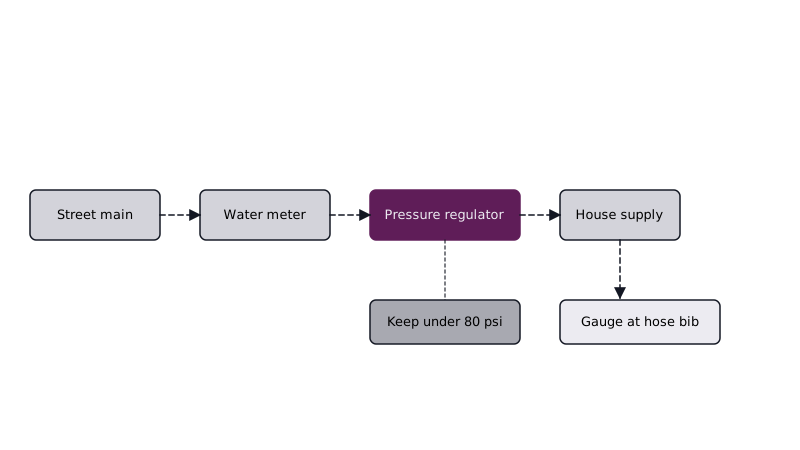
Things to check:
- The house's main shutoff valve, which should be open all the way.
- A regulator stuck at a low setting. Where a regulator is located and water pressure and valves give more.
- Neighbors. If the block is affected, call the water district. Your bill names yours, because a few districts serve Murrieta.
- Recent work. If a plumber or contractor just shut off water, something may have been left half-open or debris dislodged.
The reverse matters too: pressure above 80 psi is above what the California Plumbing Code allows and can cause leaks, a dripping relief valve and a short heater life. See the water heater pressure regulator page.
How does a tankless heater with weak flow differ?
A tankless unit needs a minimum flow before it fires and has a maximum flow it can heat. A scaled heat exchanger, clogged inlet filter or low gas supply can cut output, so the water seems weak or lukewarm. Clean the inlet screen if the manual shows how, and book a descaling or service call.
Tankless models are sensitive to hard water. See tankless service and repair. Gas supply problems and venting are contractor work, and a gas smell means you should step outside and use the SoCalGas line, 1-800-427-2200.
What about low pressure in a hot water heating system?
Some homes have a hydronic heating boiler rather than a tank heater, and those have their own pressure gauge, normally reading low when cold. That is a closed heating loop, not your tap water. Low reading there means topping up or a leak, and boiler work is a job for a specialist. If your home heats with a furnace and ducts, skip this section.
When is it worth calling a plumbing business?
Ring when the weak flow continues after you clean aerators and check valves, the water is rusty, the heater leaks, the regulator seems faulty, or you cannot tell a hot-side fault from a supply problem. A plumber can read pressure at several points and find the bottleneck. Rust and pinhole leaks mean piping trouble.
Before the visit, jot down which fixtures are weak, when it began and what changed. Weakness on hot only is a useful clue. If you do find a leak, EPA WaterSense notes an average home losing over 9,300 gallons a year through leaks, so fix drips early.
Ask for help on the quote page. Requests are forwarded to local plumbing businesses, which pay us a fee, and the one that visits sets the price. Go back to the Murrieta Creek Plumbing home page for other services.
Common questions
How long does finding the cause usually take?
Simple ones, like an aerator or shutoff valve, take minutes. Tracking down a restriction inside the piping can run an hour or longer. Replacing a mixing valve or heater parts adds time. The plumber can say after the first pressure readings.
Which questions suit a plumber on low hot water pressure?
Find out what they will test first, whether pressure is measured at the hose bib and at the fixture, whether the heater valves and regulator are part of the check, and what any repair will cost before they do it. Request that worn parts be shown to you.
Does turning the heater temperature up improve pressure?
No. Temperature changes how hot the water is, not how hard it flows. A higher setting also speeds scale and raises scald risk, so keep it moderate. If the water feels weak and lukewarm together, the problem is more likely a restriction or the heating element.
Can a water softener reduce pressure?
It can. Resin that has clogged, a partly closed bypass or a restriction at the head cuts flow through the whole house, not just hot taps. Try the bypass to see if flow returns. A softener on the supply feeding the heater would affect both hot and cold.
References
Last changed