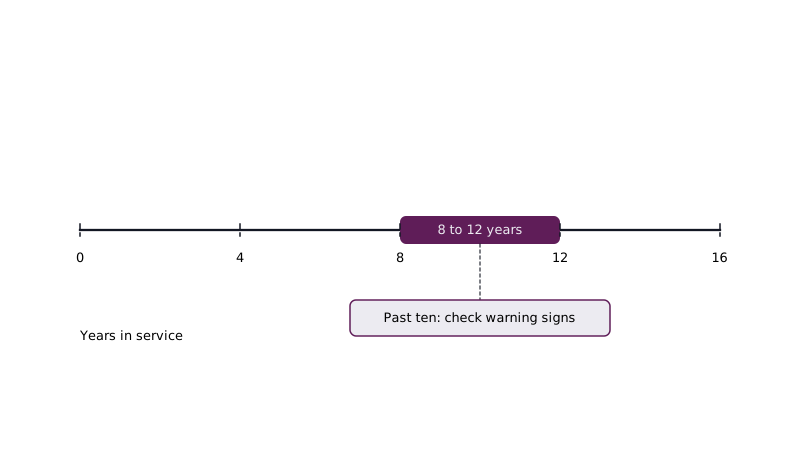
Budget for a new standard tank water heater at roughly eight to twelve years, a common estimate rather than a promise. Read the date on the label. When a heater is past ten years, rust, banging or leaks mean it is on borrowed time. Newer Murrieta homes are starting to reach that age. For other jobs, see the water heater repair guide.
Is there a fixed age at which a heater has to go?
There is no legal deadline. The usual guide is eight to twelve years for a tank unit, longer for many tankless models. Symptoms matter more than the date. A heater that is ten years old, leak-free and delivering steady hot water can keep going, while one only six years old in hard water may fail early.
To find the age, read the serial number printed on the rating label, which usually encodes month and year. The manufacturer's website decodes it, or the plumber can. Date and model matter for warranty questions too.
Factors that shorten or extend life:
- Water quality. Hard water builds scale on the bottom and on elements. Third-party estimates usually rate Murrieta water as moderately hard to hard, and your district's water quality report tells you more.
- Anode rod condition. It protects the steel and wears out first.
- Pressure. High supply pressure strains the tank and the relief valve. See water heater pressure regulator guidance.
- Temperature setting. Hotter water hurries scaling.
- Install quality and location. A heater in a hot garage with a bad vent is stressed.
What signs say the heater is ending its life?
Rust in the hot water, noises like rumbling or popping inside the tank, moisture around the base, a heater that runs constantly yet struggles to heat, and rust at the fittings all point to the end. If the heater is older than ten years, any one of them usually means replace, not repair. Water at the base means the tank itself.
Warning list, rough order of seriousness:
- Puddle or dampness under the tank. The guide to repairing a water heater leak helps here.
- Water the color of rust, from hot taps only.
- Loud rumbling, which is sediment cooking at the bottom.
- Lukewarm water that gets worse every month.
- Repeated repairs in one year.
- The relief valve dripping often. Sometimes that is pressure, not the tank.
Fix a failing element or thermostat when the tank is healthy and the unit fairly young. Pass on a repair that would swallow a big part of what a replacement costs; the plumber can help you make that call. Before you decide, compare the cost of a 50 gallon replacement with general replacement costs.
How frequently does the anode rod need inspection or replacement?
Many plumbers suggest an inspection every two or three years, with replacement once the rod is mostly eaten away, often leaving the steel core visible. In areas with hard water, check on the early side. A new rod can add years, though only when the tank remains healthy inside.
Practical points:
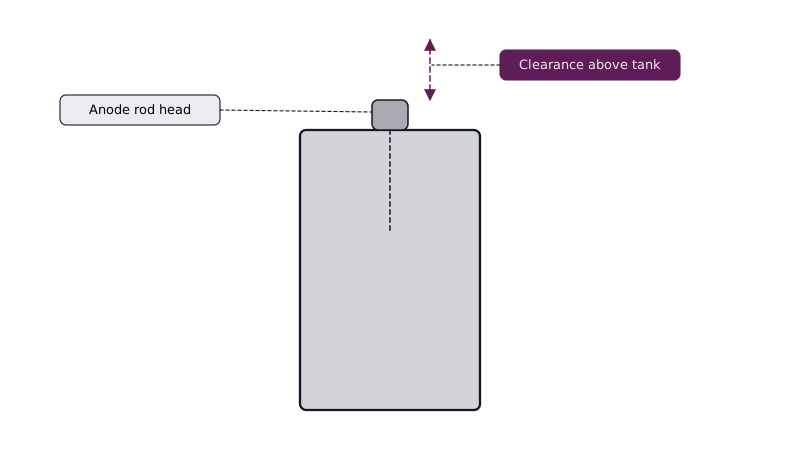
- The rod threads into the top of the tank. It needs clearance above the heater to pull it out, and some come as a flexible, segmented type for tight closets.
- Some heaters carry a powered rod. Those are different, so read the manual.
- An old rod can seize. Using force risks harming the tank or fittings.
- If it is already corroded to a wire, the tank has been exposed to rust for a while.
Steps and options appear in anode rod replacement.
Is flushing a decade-old heater a good idea?
Most manufacturers advise annual flushing, but if an old heater has never been flushed, opening the drain valve can dislodge sediment that was plugging a rust hole, and a leak can start. When the tank is in decent condition, flush gently. If it is already damp or rusty, skip it and plan a replacement.
How to flush:
- Cut the power, or put the gas control on pilot.
- Close the cold inlet.
- Attach a hose to the drain valve and lead it to a safe drain. The water is hot.
- Upstairs, turn on a hot tap so air can get in.
- Drain until the water runs clear, then briefly reopen the cold inlet to stir sediment and drain again.
- Close up, refill with a hot tap open until water flows without sputtering, then restore power.
Never power up an electric heater before the tank is full. That burns the elements. Drain valves can clog with sediment, and plastic ones can break. Replace those with brass if you have to.
Do tankless water heaters last longer?
Generally yes, with maintenance. Makers often cite up to about twenty years for tankless units, though we have not verified any figure for Murrieta, so treat it as a rough claim. Scale is the problem for them too. Descaling, as the manual describes, keeps the heat exchanger working.
See tank versus tankless for the trade-offs.
What should you know before replacing one?
A new heater generally calls for a permit, and California also requires earthquake bracing on water heaters. For addresses in the city, the City of Murrieta Building and Safety Division issues permits, and county offices serve unincorporated areas such as French Valley and Winchester. Ask the plumber who applies for it, and whether the quote includes the fee.
Do not expect a zero-NOx rule to force a switch. In June 2025 the regional air board decided not to amend its water heater rules, so sticking with the usual gas or electric choice is fine. Tell the plumber if you want to change fuel, since that changes the work: gas line, venting and electrical all follow.
To have someone take a look, request a quote. Requests go from us to local plumbing businesses that pay us a fee, and the price comes from the one that visits. Read how it works or head back to the Murrieta Creek Plumbing home page.
Common questions
Is it worth fixing a heater that is ten years old?
That hinges on what failed. A new thermostat, element or thermocouple is a modest fix on a sound tank. A leaking tank is never worth fixing. If the repair costs a big share of a new heater, putting that money toward a replacement usually makes more sense.
Can I make a heater last longer?
Yes. Flush it yearly, check the anode rod every couple of years, keep the temperature setting moderate, and make sure supply pressure is not too high. An expansion tank helps in closed systems. None of it is a promise, but it removes the common causes of early failure.
Do electric tanks outlast gas ones, or the other way round?
Many sources put them in a similar range, with electric sometimes lasting a bit longer because there is no burner or flue. We have not verified a single figure, so use the age of your own unit and its condition as the guide, not a table.
Is it smarter to swap the heater ahead of a breakdown?
Past ten years, with warning signs showing, yes, as long as you can schedule it. A planned swap lets you compare quotes and choose the unit. A breakdown at a bad moment brings a wet floor and a rushed purchase. Placing a leak sensor or drain pan helps either way.
Last changed