A gas tankless install puts a wall-mounted unit in the house that heats water only while it flows. It needs enough gas line capacity, an outdoor vent, a condensate drain on most models, power and a permit. Because the work is regulated, a contractor does it. For the wider picture, see our overview covering repairing and replacing a water heater.
What does a gas tankless installation cover?
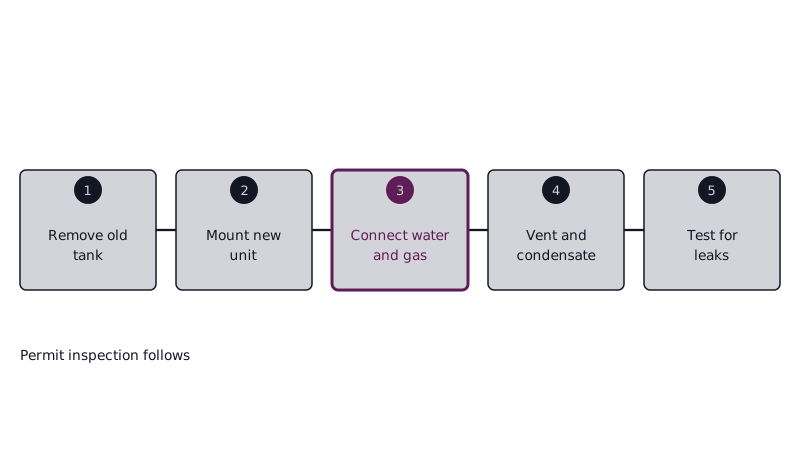
The old tank or older unit is taken out first. The plumber then mounts the new heater, hooks up water, gas, vent, power and condensate lines, adds isolation valves for future servicing, and tests for leaks, combustion and temperature. Many jobs also need a bigger gas line and new venting, which is where most of the extra work lies.
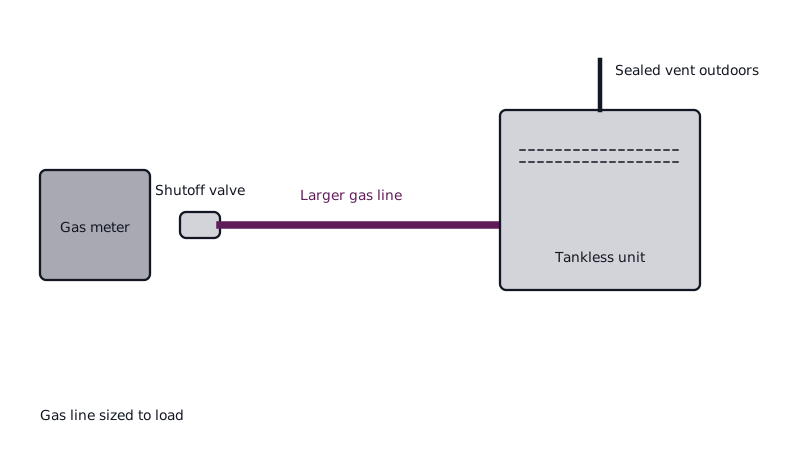
Because the unit fires only while hot water flows, it demands a large burst of gas, often more than a tank heater. When the existing gas pipe cannot carry the new load, a larger line must be run from the meter or close to it. Have the plumber state the gas demand in BTU, and the pipe size and length, in the quote.
Venting depends on the model. Direct-vent and condensing units usually use plastic pipe out through a wall or roof, while some use stainless. Condensing models produce acidic condensate that must drain to a proper point, sometimes through a neutralizer. Walls, clearances and the route all affect the price.
What should you look over at home before the quote?
Note the age and type of your current heater, where gas and water enter the house, how far the meter is from the heater spot, whether an outlet is close and how much wall space is free. Take photos and count the bathrooms and fixtures that run at the same time.
Size matters. A tankless unit is rated by how many gallons per minute it can heat for a given temperature rise, so a family that showers and runs the dishwasher together needs more capacity than a couple. A plumber will ask about fixtures and incoming water temperature. Do not buy a unit from a store until the plumber has checked these.
If your home runs on propane or has no gas service, a natural gas model will not suit it, and an electric unit has different demands, as in electric tankless installation. In Murrieta and nearby areas, SoCalGas is the expected gas utility where there is gas service; check your bill, and many rural lots use propane or electric.
Is a permit required, and who may do the work?
Yes. Replacing a water heater or adding a gas appliance generally calls for a permit, and the work goes to a contractor with a California license. The state generally demands that license at $1,000 or more in labor and materials, and for any permit job. You can look up a license on the CSLB website.
Your local building office issues permits. For the city of Murrieta, the Building and Safety Division takes calls at 951-461-6062. Wildomar's Building and Safety, at 951-677-7751, lists a counter open on weekdays. Unincorporated areas such as French Valley and Winchester use Riverside County Building and Safety, so confirm the office and hours before visiting.
The inspection checks gas connections, venting, clearances and the safety devices. Keep the permit paperwork. Gas appliance work should never be done yourself, and a poor vent can create carbon monoxide, so install an alarm near sleeping areas whatever you choose. Should you ever smell gas, walk out of the building, ring SoCalGas on 1-800-427-2200 from the yard, and call 911 if anyone is in danger.
How does a tankless heater compare with a tank in cost and running?
A tankless unit usually costs more to buy and install but takes no floor space, heats on demand and avoids standby heat loss. A tank is cheaper to fit and simpler, but takes space and can run out. The better choice depends on household use, gas capacity and budget. We state no dollar figures because none has been confirmed.
For a head-to-head, see comparing tank and tankless water heaters and tankless gas versus tank; tankless installation cost covers what changes a quote. Ask about rebates from your utility, but do not rely on one without reading the terms.
Hard water is a real factor here. Third-party estimates put Murrieta tap water in the moderately hard to hard range (roughly 6 to 11 grains per gallon), and scale reduces the efficiency and life of a tankless heat exchanger. Ask about a scale filter or a softener, and plan a periodic flush. The district report or a test strip tells you more about your own address.
On emissions, the regional air board's June 2025 decision not to amend its water heater Rules 1111 and 1121 means no new zero-NOx requirement is pending. Still, have the plumber confirm that the model is approved for sale and use in California.
How do you choose and arrange an installation?
Get a written quote naming the model, gas line work, vent route, condensate handling, permit, haul-away and any wall patching, plus the warranty terms, and compare at least two. To have a plumber come out, use the price request form; we hand requests to local plumbing businesses, which pay us a fee.
Pick a size from the fixture count, not just the family size. Ask what the plumber would install if the first choice is not possible, and why. Confirm that the heater will be set up with isolation valves so it can be flushed. The home page explains how requests reach local businesses.
You may want brand-specific details. Pages on Rinnai tankless installation and Navien tankless installation cover those, and water heater replacement cost places the project against a standard tank swap.
Common questions
How much time does a gas tankless installation need?
Many finish within a day, but a new gas line, a fresh vent route or opened walls can stretch it, and the permit inspection comes on top. After seeing the site, the plumber can give an estimate. Plan on the water and gas being off during part of the day.
Can a tankless heater use my existing gas line?
Sometimes. It depends on the pipe size, run length and whatever other gas appliances share the line. The plumber calculates the load and decides whether it is enough. Do not assume the old tank's line will work, because tankless units draw much more gas at peak.
What belongs on a gas tankless quote?
Check that it names the model and its gas input, gas pipe size and length, vent route, condensate handling, permit and inspection, removal of the old heater and the warranty terms. If any of those is missing, ask. Also ask what happens if inspection finds a problem.
Does a tankless heater keep working in a power outage?
Usually not. Most gas tankless units rely on electricity for the fan, igniter and controls, so they shut down when power fails unless a backup supply is attached. A tank heater with a pilot light or simple controls may carry on. Ask about this if outages concern you.
Last changed