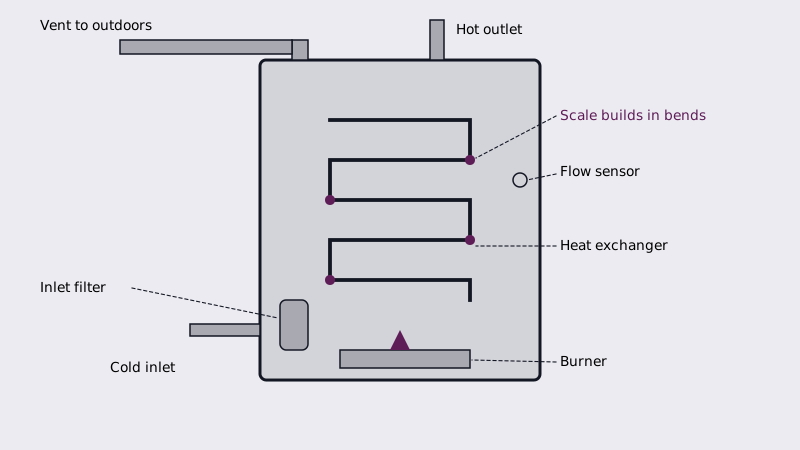
Repairing an instant water heater starts with working out why a tankless unit delivers no hot water, lukewarm water, or an error code, and then fixing or replacing the failed part. The usual causes are scale inside the heat exchanger, a dirty inlet filter, a flow or ignition fault, or a vent problem. This page sits in our water heater repair section.
What usually goes wrong with an instant water heater?
Typical faults include scale choking the exchanger, an inlet screen that has clogged, a failed igniter or flame sensor, a flow sensor that misreads, a venting or condensate problem, and a power or gas supply interruption. Most appear as error codes, cold water at low flow, or water that swings between hot and cold.
Scale is the one to watch in this area. Third-party estimates from the 2023 to 2025 report years generally describe Murrieta tap water as moderately hard to hard, roughly 6 to 11 grains per gallon, though your address may differ. Read your water district's quality report, or try a test strip. Hard water leaves mineral deposits in the narrow passages inside a tankless unit, which reduces flow and raises the temperature at the exchanger.
Symptoms point to causes. Water that turns cold only at low flow often means a minimum flow issue or dirty screens. A fluctuating temperature points to scale or a sensor. A unit that clicks without igniting suggests the igniter, the gas supply or the flame rod. The meaning of a displayed code in the manual narrows things down faster than guessing.
How do you get an instant water heater repair arranged?
Tell us the brand, the model, any code on the display and what the water is doing, and we pass the request along to a nearby plumbing company. Use the price request form or the phone number at the top of the page. Companies taking requests pay us a fee, and each gives its own quote.
Having the model number, the age of the unit and a photo of the display saves time on the first call. Mention whether you are in the city of Murrieta or a county area such as Winchester, Wildomar or French Valley. The home page lists the places we cover.
Which checks can you do before booking a repair?
Check the basics first: the power switch and outlet, the gas valve, the water shutoff valves, any error code on the display, and the cold-water inlet filter. Write down the code and look it up in the manual. Reset the unit once by switching it off and on. Never open the gas side or the sealed combustion area yourself.
A short checklist, in order: confirm the unit has power and the display is lit; confirm the isolation valves are fully open; check that other taps flow normally, since low supply pressure can trip a flow sensor; inspect the vent termination outdoors for blockage from leaves, nests or debris; and record the model and serial number from the label.
If the code mentions ignition, flame, venting or exhaust, stop and call. Those parts involve gas and combustion air. If you smell gas, exit the house, ring SoCalGas on 1-800-427-2200 once you are outside, and call 911 should anyone be at risk. Carbon monoxide alarms near the unit are worth having, and replacing batteries is cheap insurance.
Who is allowed to do the repair, and is a permit needed?
California requires a contractor license once a job hits $1,000 in labor and materials, and for permit work of any size. Replacing a water heater generally takes a permit, and gas piping and venting are regulated work. Inside Murrieta, the Building and Safety Division, at 951-461-6062, can say whether your job needs one.
Cleaning a filter is minor, while changing gas parts is not. Ask the plumber to explain which one your job is and who pulls any permit. In French Valley, Winchester and other unincorporated areas the office is Riverside County Building and Safety; confirm it before visiting, since details can change.
Look up the license on the CSLB website. Ask whether the business has experience with your brand. A plumber who works on the brand regularly will diagnose faster and avoid trial-and-error parts changes.
Should you repair the unit or replace it?
Repair usually wins when the fault is a single part or scale and the unit is well short of the end of its life. Replacement is worth pricing when the exchanger has failed, repairs keep coming back, or parts are no longer made. Request both options in writing from the plumber and compare the totals.
Age matters, but we do not state a life span here because it depends on the brand, water and maintenance. Read the manual and the warranty terms, and ask what is still covered, since some manufacturers cover exchangers for a period only when installed and serviced as required. Keep your receipts.
A tankless install has specific demands: gas line size, venting, condensate drainage and electrical supply. Read about gas tankless installation and replacement cost before you decide. If a tank unit has no hot water at all, the guide to no hot water may fit better.
What does a plumber do to fix a tankless water heater?
The plumber reads the error code, tests flow, gas supply and electrical connections, and inspects the heat exchanger, igniter, flame sensor, fan and vent. A descaling solution and a pump flush out the scale, and failed parts such as sensors or valves are swapped. The unit is then tested for temperature and flow.
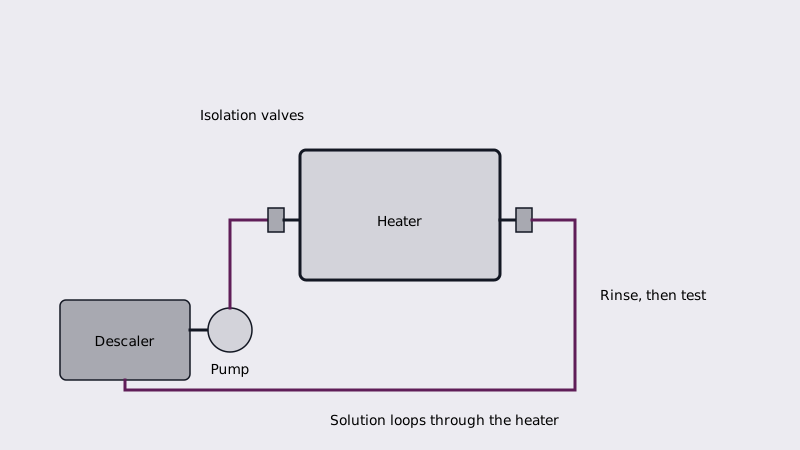
A descaling flush is the most common single job. It circulates a mild acid solution, often vinegar or a manufacturer-approved descaler, through the unit for a set time, then rinses it. Many manufacturers advise repeating it at set intervals, with shorter gaps in hard-water areas, so check your manual and keep records. Some people add a water softener to protect all fixtures, which our page on softeners and hard water explains.
Parts availability depends on the brand. Brand pages cover Navien, Rinnai, Rheem and Noritz units, and a general guide on tankless water heater service and repair.
Common questions
How long does an instant water heater repair take?
A descale flush or sensor swap can often wrap up within one visit lasting a couple of hours, while a part that must be ordered adds waiting time. The plumber should say what the diagnosis shows and whether the fix needs a second visit.
Why does my tankless heater give hot then cold water?
That swing is often called the cold-water sandwich, though scale, a faulty sensor or a flow too low for the unit to sustain can cause it too. Open the tap fully, check screens and look at the code. When the swings continue, have a plumber test flow and temperature.
What flushing schedule suits a tankless heater?
Manufacturers typically recommend periodic descaling, with shorter gaps where water is hard, so follow your manual for the interval. Keeping a dated record also helps with any warranty claim. A plumber can set the schedule from your model and how much scale the first flush removes.
Is a tankless repair worth it on an older unit?
That depends on what failed and what else is wearing. An inexpensive part such as a sensor or filter is usually worth fixing. A cracked exchanger, or faults that keep recurring, may tip the balance toward replacing the unit. Get both prices in writing, and check the warranty before deciding.
Last changed