Whether a leaking water heater can be repaired depends on the source of the water. Drips from a pipe fitting, the drain valve or the relief valve line are often fixable. Seepage through the tank body is not, since the steel shell has failed and the unit needs replacing. The steps below cover reading the leak, shutting things off safely and deciding what comes next. For more context, go to the water heater repair page.
Where is my heater leak coming from?
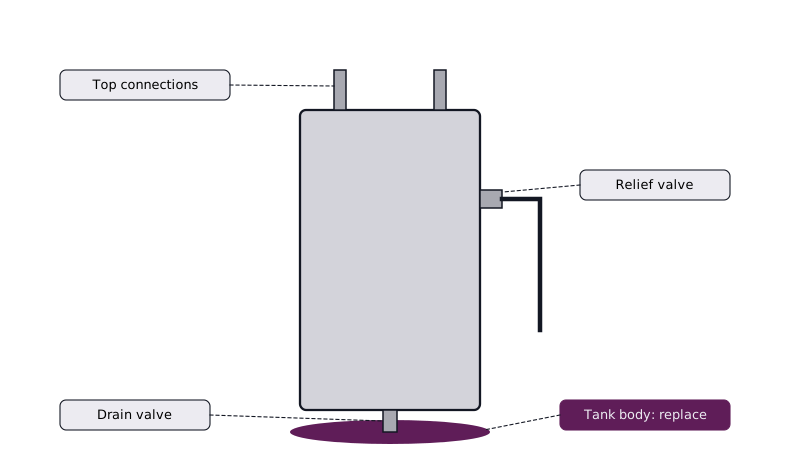
Wipe the heater and floor dry, then wrap a dry piece of paper towel around every connection and wait twenty minutes. The paper that turns wet marks the source. Moisture on top suggests the inlet and outlet fittings. Moisture partway down the tank usually means the relief valve. Moisture at the base means the drain valve or the tank itself.
Use that map as a rough guide:
- Top of the tank: the hot outlet and cold inlet connections, often with a flexible connector. A loose or corroded one can drip down the sides and look like a tank leak.
- Side of the tank: the T&P relief valve and its discharge pipe. A steady drip from that pipe means the temperature or pressure is running too high.
- Bottom front: the drain valve. Snugging it a few turns with a wrench, or fitting a new one, often stops it.
- Bottom, underneath, all around: probably the tank. Skip repairs.
- Damp but not dripping, only on cold mornings: condensation, which is normal on some gas heaters while they warm up.
Cooler floors, a rusty pan or a metallic smell can also point to a slow tank leak. See our note on replacing a water heater if the base is the culprit.
What do I shut off before touching a leaking heater?
Close the cold water inlet valve above the heater, then cut the energy. For electric models, switch off the breaker. For gas models, set the gas control knob to either pilot or off. A tank that heats while empty or half full can burn out its elements, so never skip this step, even if the leak looks small.
In order:
- Shut the cold inlet valve (a handle parallel to the pipe means open, a crosswise handle means closed).
- Power: breaker off for electric, gas knob to off for gas.
- Open a hot tap elsewhere so air can enter and the tank drains instead of vacuuming.
- If the tank must be empty, attach a hose to the drain valve and lead it outside or to a floor drain. The water can be hot enough to scald, so wait for it to cool first.
- Photograph the label with the model and serial number before you call anyone.
If the room smells of gas, stop. Everyone leaves first; once you are all out, use the SoCalGas line, 1-800-427-2200. Do not flip any switches. Gas appliance connections are contractor work.
Which water heater leaks are safe to fix on my own?
A loose or worn inlet connector, a weeping drain valve or a dripping relief valve discharge is usually within reach once you know why it drips. Gas piping, a venting change or a new tank are another matter: a new tank usually requires a permit, while gas work must go to a contractor.
A realistic split:
Reasonable DIY
- Tightening a compression or union fitting, or swapping a flexible connector.
- Replacing a plastic drain valve with a brass one.
- Checking the thermal expansion tank air charge.
Call a plumber business
- Any leak from the tank itself.
- Relief valve replacement if you are not comfortable draining the tank.
- Gas supply, vent or flue changes.
- Anything inside the pan after more than one repair.
A dripping relief valve may simply be doing its job. Supply pressure can climb as the heater warms the water, and if nothing absorbs the rise, the valve opens. Excessive incoming pressure is a frequent cause. See water heater pressure regulator basics and the page on water heater expansion tanks. The plumbing code limits supply pressure to 80 psi, so testing with a gauge is worthwhile.
Can a leaking tank be patched?
No. Epoxy, tape and sealant on a steel tank hide a hole for a few days at best. Once rust has breached the inner shell, more holes follow, and water can burst out without warning. Replace the tank. If it is a few years old, check whether the manufacturer covers it.
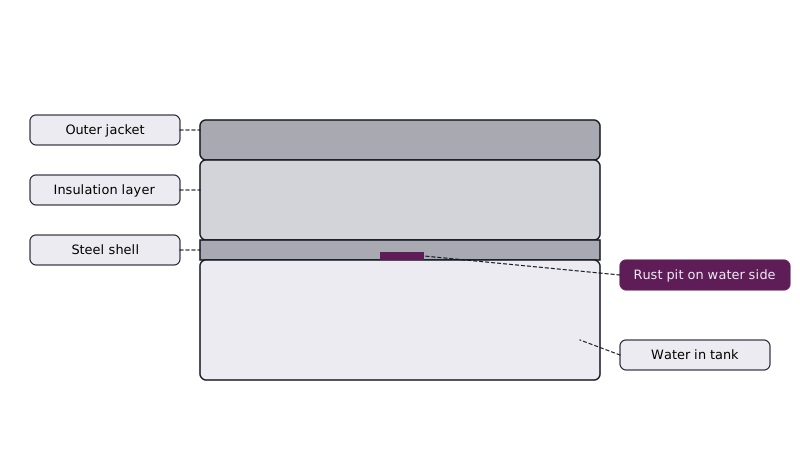
Tanks fail from the inside. Hard Inland Empire water deposits scale, and the sacrificial anode rod that protects the steel wears out. Replacing it early can extend a heater's life. See anode rod replacement. Many tanks last roughly eight to twelve years by common rule of thumb, but yours may not. A heater that leaks from the body at that age is simply finished.
Replacing a heater in California generally takes a permit, and earthquake bracing is mandatory. For addresses within the city, the City of Murrieta Building and Safety Division issues permits. County offices handle unincorporated areas such as French Valley and Winchester. If you are unsure which applies, ask before work begins. Cost of a new unit is covered in the guide to water heater replacement prices.
What about a tankless water heater that leaks?
Tankless units leak at the water connections, the condensate line (on condensing models) or the heat exchanger. Connections and a blocked condensate drain are fixable. A cracked heat exchanger is a repair for the manufacturer's service network or a replacement. Do-it-yourself tankless installation involves gas sizing and venting, which is contractor work.
Mineral scale is the usual enemy here. Descaling with a pump and vinegar is a routine task for some owners, though the manual for your model comes first. If yours is wall-mounted, see servicing and repairing tankless heaters.
What if the hot water is gone and nothing is leaking?
Start with the basics: breaker, pilot light, gas knob, thermostat setting and the reset button on electric units. A leak can also lead to this problem, since a drained or tripped heater stops heating. If you shut the system down because of a leak, that explains the lack of hot water.
Quick checks for no hot water with no leak:
- Electric: breaker tripped, upper or lower element failed, or reset button popped.
- Gas: pilot out, thermocouple worn, gas supply valve closed.
- One fixture only: look at that fixture's cartridge or mixing valve instead.
Our no hot water guide walks through each.
Where does a plumber visit fit in?
If the tank body leaks, the unit is gas, or you cannot tell which valve does what, ask for a local plumber. Requests go from us to local plumbing businesses that pay us a fee, and one of them contacts you. That business sets the price once it has seen the job. Try the quote page, or see how this works.
Leaks cost more than the water. Water running onto subfloor or drywall invites mold and rot. EPA WaterSense reports that an average household loses more than 9,300 gallons each year to leaks, and a heater leak is rarely small for long. Go to the Murrieta Creek Plumbing home page for other help.
Common questions
How much time does fixing a leaking heater take?
Replacing a fitting or valve is often finished in under an hour once the tank has drained, though draining itself can take a good while. A full tank replacement runs half a day to a whole one, depending on venting, permits and access. The plumber can narrow that down after looking at the unit.
Which questions should I put to a plumber before the work begins?
Ask whether the leak is repairable or the tank is finished, whether a permit is included, whether the new unit will be braced, and where the old one will go. Request the model, the capacity and the full price in writing before anything is ordered. Ask whether gas connections will be pressure tested.
Is it fine to use hot water until the repair happens?
Not from a leaking unit. Once the cold inlet is closed and the heater is off, hot water stops, and reopening the valve just feeds the leak. If the leak is only at a fitting and you can catch the drip in a pan, some people reopen it briefly, but turn it off overnight and whenever you leave the house.
Can a minor water heater leak be a safety risk?
Yes, it can. Water near the electric controls is a shock risk, and water at a gas burner can put out the flame and cause trouble. A slow tank leak can also let the tank fail suddenly. Shut off the heater and the cold water, and do not stand in puddles near wiring.
Last changed