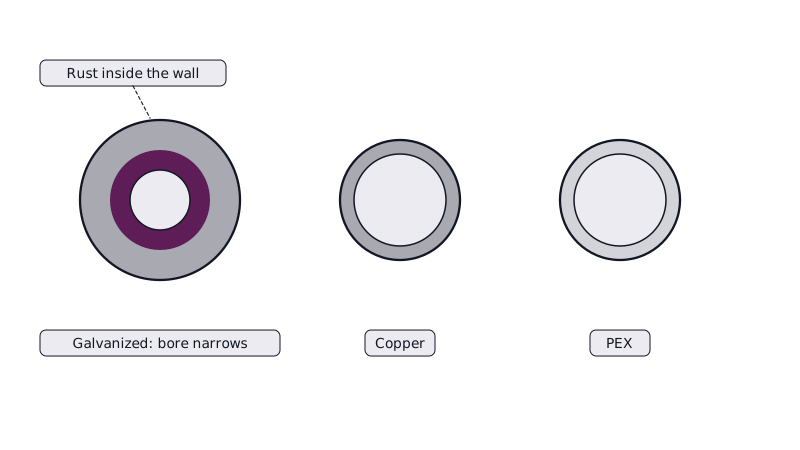
Galvanized pipe is gray steel with a zinc coating, and it was the standard for house water lines until about the middle of the last century. With time the zinc erodes, the steel rusts, and the bore narrows. Swap it for copper or PEX once pressure drops, water turns brown, or leaks begin. This is a whole-house job, covered in the guide to repiping and pipe replacement.
How do you check a Murrieta house for galvanized pipe?
Look at exposed pipe by the water heater, below sinks, along the garage wall or near the meter. Dull gray metal with threaded joints that attracts a magnet is galvanized steel. Copper looks orange-brown or green, while PEX is bendable plastic tubing, colored red, blue or white. A scratch test with a screwdriver shows silver-gray under the surface.
Roughly half of Murrieta's housing dates from 2000 or later, so galvanized supply pipe is uncommon in the city overall. Where you could find it: older houses near Old Town Murrieta and Murrieta Hot Springs, and older rural properties around the edges of the area. We have no figures for each neighborhood, so look at your own pipe.
Start with the age of the house. Newer homes are far less likely to have steel supply lines, whereas one dating to the 1950s or earlier may have them. A short plumber visit can confirm it.
What makes galvanized pipe fail, and what shows up first?
Rust accumulates inside the pipe and narrows the passage, so flow drops long before a leak shows. Brown or rust-colored water after the tap has been off, weak pressure at the fixtures farthest from the meter, and pinhole leaks at threaded joints are the usual signs. Replacement is the cure, not cleaning.
Pressure problems are gradual. A shower that used to be strong now trickles, and running two fixtures at once cuts both. To rule out other causes first, our page on low water pressure takes you through them.
Hard water speeds the narrowing, because scale forms on the rust. Third-party estimates rate Murrieta tap water as moderately hard to hard, and your district's report is the better guide for your address.
Lead is a separate question. For worries about lead in an older home, the water district is the one to ask about testing. A plumber is the wrong person to settle a health question, and the district's report is the place to start.
What does the replacement work look like?
A plumber maps the supply, closes the water off, pulls new copper or PEX to each fixture, and ties it in at the meter side and the water heater. Walls and ceilings get small access holes that are patched afterward. The old pipe is abandoned in place or removed where accessible. Then the system is pressure tested and inspected.
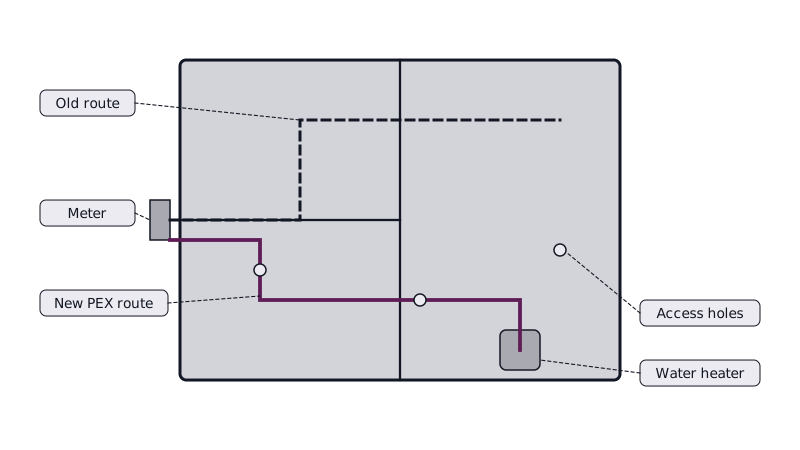
The big decision is material. PEX is flexible, goes through walls with fewer holes and costs less in labor. Copper is rigid and lasts a long time, though it is more expensive and slower to fit. Read PEX versus copper before you choose, and look at the repipe cost and PEX repipe cost pages for price context.
One failing section may allow a partial repipe, but if the remaining pipe is the same age, a full replacement saves money in the end. The reasoning is laid out in the repiping timeline, and why people repipe covers the reasons.
How long will a repipe keep me busy?
A full repipe on an average house often runs several working days, depending on size, access and how much wall patching is included. The water will be shut for several hours daily, and the plumber should name those windows. Drywall patching and painting may be a separate trade and take longer.
Ask the plumber for a schedule on paper that lists the hours without water and who handles patching. A one-story slab house with attic access is simpler than a two-story home with tight walls. Plan for no water at certain hours, and keep drinking water and a way to flush a toilet.
No set number of days is offered here, because every house differs. If a business promises one before seeing the home, ask how they arrived at it.
Is a permit required to repipe my home?
Generally yes. In California, repiping is plumbing work that typically involves a permit plus an inspection, and the contractor pulls the permit. In Murrieta the permit office is the City of Murrieta Building and Safety Division (951-461-6062); in Wildomar it is the City of Wildomar; for unincorporated French Valley and Winchester it is Riverside County.
In California a contractor license is generally needed once labor and materials hit $1,000, and always when a permit applies. Ask for the license number, then look it up on the website of the Contractors State License Board. Any business hinting that you skip the permit is a red flag, and an insurer may refuse a claim on unpermitted work.
Is there a program that pays for polybutylene replacement?
We could not verify a current program, so do not plan around one. Polybutylene, a gray plastic pipe, was mostly installed before 1995. Ask your insurer and your title or inspection records whether any claim route still exists, and treat that as unlikely until someone shows you paperwork. See our guide to polybutylene replacement.
Because most Murrieta homes are newer than the polybutylene era, many owners will never meet it, but a house from the early 1990s or earlier may still have it.
Ready to compare? Send a quote request that gives how old the house is and what symptoms you see. Your request goes to local plumbing businesses, which pay us a fee for taking requests, and the one that replies quotes and does the work. For how the job runs, see how to repipe a house. See the home page for other services.
Common questions
Is it fine to keep galvanized pipe while the water looks clear?
For a while, yes, but the inside keeps narrowing, and leaks tend to appear at joints without warning. Clear water today does not tell you how much bore is left. Having a plumber test flow and pressure at several fixtures will show how much life remains.
Will replacing pipes change my water pressure?
Usually pressure improves at the far fixtures, since the new pipe has a wide, smooth bore. The pressure at the meter does not change, and the regulator setting matters too, so ask the plumber to check the regulator at the same visit. California's plumbing code sets its pressure cap at 80 psi.
Does a repipe need walls opened?
Some access holes are normal, especially with copper, and PEX usually needs fewer. A plumber can often route pipe through attics, crawl spaces and closets to limit damage. Before agreeing to the price, find out the hole locations and whether the plumber or another trade patches and paints them.
What should I ask first before picking a repiping business?
Request the contractor license number, plus details on permit handling, the pipe material, the schedule, and whether patching is included. Get every answer in writing. The business that replies to your request quotes the job in writing, and this site does not do plumbing itself.
References
- General home plumbing practice and California permit practice; no price figures on this page
Last changed