We are a plumbing request site, not an insurer, and nothing here is insurance advice. Standard homeowners policies commonly treat an accidental burst that happens suddenly as a covered cause of damage to the house and belongings, while wear, neglect and the cost of the pipe itself are not. Read it alongside our guides to leaks and bursts.
When does a homeowners policy usually pay for burst pipe damage?
Typically when the water release was sudden and accidental, and you acted fast. In that case the policy may pay to dry out and repair floors, drywall and fixtures damaged by the water, and to replace ruined belongings, minus your deductible. The policy language decides, and the claims line can tell you how yours treats it.
Insurers tend to ask what happened, when you found it and what you did next. A quick shutoff and prompt report help. If damage grew because nobody stopped a known leak, some policies reduce or refuse payment. Keep your policy declarations page where you can reach it.
Which steps come first so the claim stays strong?
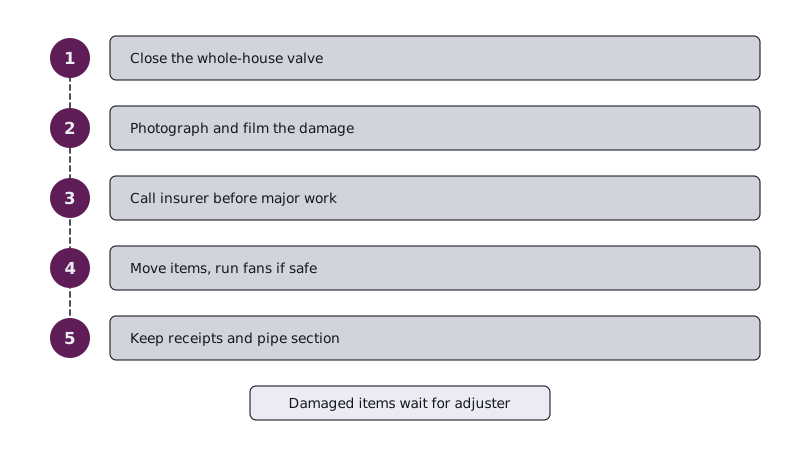
Stop the water, take photos and video of the damage ahead of any cleanup, and hold on to the failed pipe piece when the plumber hands it over. Then call the insurer early. Do not discard soaked items before the adjuster has looked at them, and keep every receipt for emergency repairs and dry-out.
The order that tends to work:
- Close the whole-house valve and tell the plumber exactly what you saw. See emergency burst pipe plumber for the immediate steps.
- Take wide shots, then close-ups of each wet area, and a short video panning the room.
- Phone the insurer and ask what they want before work begins, including whether they need to approve a dry-out company.
- Make temporary protective steps: move belongings, run fans if safe.
- Keep paperwork: plumber invoice, photos of the failed section, a list of damaged items along with rough ages.
How are aging pipe, pinholes and repiping treated?
Insurers generally do not pay to replace aging pipe because it is a maintenance item. Some may look at the age and material of the plumbing when writing or renewing a policy, which is a question for your agent. A pinhole that sprays suddenly can be treated differently from a slow weep, again according to the policy wording.
If your house has had repeated failures, a repair record helps you decide on repiping the house. Replacing pipe before it fails is the cost you carry yourself, but it can avoid a claim and the wall work that follows.
What does a policy often leave out?
Common exclusions are the repair of the failed pipe itself, damage from slow leaks that went on for weeks or months unnoticed, rot and mold from long-term seepage, and flood or groundwater from outside. Maintenance and wear are generally the owner's cost. Sewer backup is often a separate add-on, not part of the base policy.
Wording varies. Look in your policy for the phrases sudden and accidental, repeated or continuous seepage, wear and tear, and water backup. A phone call to the agent can clear up the point faster than reading the whole contract.
Does a leak under the slab count?
Maybe. Some policies cover the water damage but limit what they pay for accessing and repairing the pipe under a slab. Because slab leaks are specialist work, read the policy and ask directly. The slab leak repair page explains the repair options and what finding the leak involves.
Does the cause of the burst change coverage?
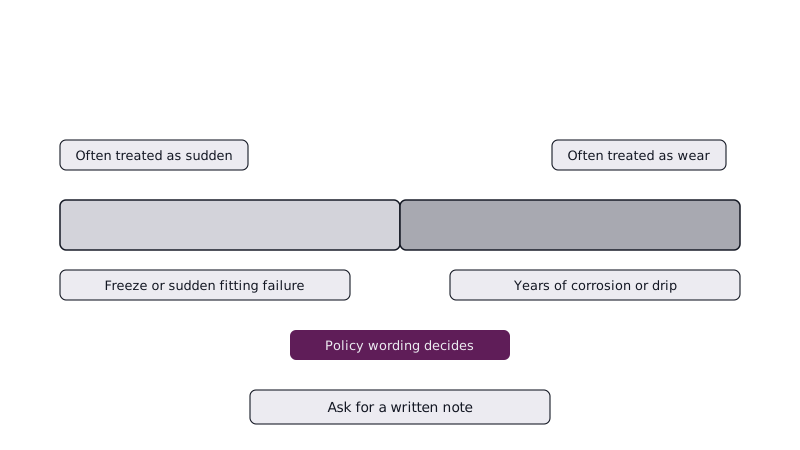
It can. A freeze, a sudden failure of a fitting or a pipe damaged by accident is more likely to be treated as sudden. Corrosion over many years, or a leak that dripped unnoticed, is more likely to be treated as wear or seepage. The plumber's description of the failure matters, so ask for a clear written note.
The causes of pipe bursts page lists the usual mechanical reasons. The plumber who repairs the pipe is not an adjuster and cannot promise coverage, but an honest note on what failed and how often helps.
Who do I call for help with the plumbing side?
Use the quote form or ring (951) 514-3204 on weekdays, 9am to 5pm. We pass your request to nearby plumbing companies, which pay us a fee for taking requests. Ask the plumber for an itemized invoice with the date, the cause and the work done. The Murrieta Creek Plumbing home page lists other services.
Common questions
Will my deductible apply?
Usually, yes. The insurer pays covered losses above the deductible stated on your policy, so a small burst with limited damage may fall below it and not be worth claiming. Ask your agent whether a claim makes sense at your deductible, and how claims are handled at renewal.
Does renters insurance cover a pipe burst?
A renter's policy generally covers your own belongings damaged by sudden water, not the building itself. The landlord's policy is the one that normally covers the structure. Tell the landlord right away, in writing if you can, then ask your own insurer how your belongings are treated.
Can I fix the pipe before the adjuster comes?
Yes, stopping the water and making a repair is expected of you, and waiting with water running can hurt a claim. Photograph first, save the damaged pipe section, keep every receipt, and let the insurer know what you did and when, ideally before the big work starts.
Will a claim raise my premium?
Possibly. Practices differ by insurer and by claim history, and we cannot speak for any of them. Ask your agent before filing, and for a wider view of insurance questions, consumer guidance for policyholders is available from the California Department of Insurance.
Last changed