If your gas water heater stays lit only while you hold the pilot button, and dies as soon as you let go, a worn thermocouple is the first suspect. The part is inexpensive: it turns heat from the pilot flame into a tiny voltage that keeps the gas valve open. Swapping it is a short repair, but it sits on a gas line, so many owners pass it to a plumber. For more background, begin with water heater repair.
Not every heater has one. Newer models with electronic ignition or sealed combustion use a flame sensor instead, and electric heaters have neither. Before buying a part, work out which kind of heater you own, then follow the checks below.
What does a thermocouple do in a water heater?
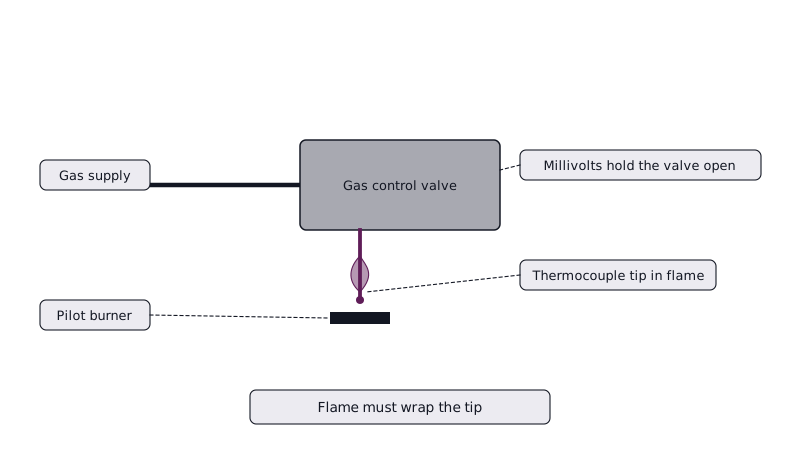
It is a safety switch. A thermocouple is two dissimilar metals joined at a tip that sits in the pilot flame. The tip heats up and produces a few millivolts, enough to keep a magnet in the gas valve held open. When the flame goes out, the voltage falls, the valve shuts, and gas stops flowing to the burner and pilot.
That is the reason a repeatedly dying pilot implicates the thermocouple. A sooty, bent or worn tip no longer produces enough voltage to hold the valve, so the gas shuts off even though the flame is burning.
The thermocouple threads into the gas control valve at one end and sits beside the pilot burner at the other. It has no moving parts, but heat and soot wear it over years.
How can I tell the thermocouple is bad?
The typical symptom is a pilot that burns only while the knob is held down. Other signs: no hot water with a cold pilot, a pilot that repeatedly goes out, or a tip that looks blackened or bent. Check that the pilot flame wraps the tip first. A weak flame or a draft can cause the same fault.
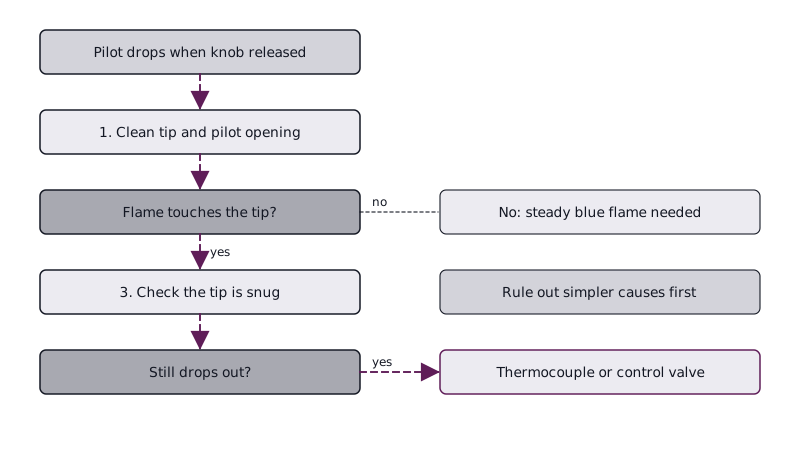
Rule out simpler causes before replacing parts:
- Clean the pilot tube opening and the thermocouple tip gently with fine abrasive.
- Confirm the pilot flame is blue and steady and touches the tip.
- Check the thermocouple is snug in the gas control, hand tight plus a small turn.
- If the pilot still drops out, the part is the likelier culprit, though a faulty gas control valve can act the same way.
A multimeter can read millivolts across the thermocouple, a step best left to someone familiar with the test. Other common faults are covered in why you have no hot water and working heater but no hot water.
Can a homeowner swap a thermocouple?
The job is small, yet it involves a gas line, so think it through. Under California rules a contractor license is required for jobs needing a permit and, generally, at $1,000 or more in labor and materials; gas piping work is regulated too. A simple part swap is less than a piping job. When unsure, hire a plumber.
If you do it yourself, the steps are:
- Turn the gas control knob to off and wait five minutes.
- Close the gas shutoff valve on the supply line.
- Remove the burner access panel and loosen the thermocouple nut at the gas control.
- Unclip it from the pilot assembly, and slide it out.
- Install the replacement where the old one sat, snug it up, reopen the gas and relight the pilot as the heater's label directs.
- Check for gas smell around the fittings.
If you smell gas, walk out first; once outdoors, ring SoCalGas on 1-800-427-2200, or call 911 when someone is at risk. In San Diego County areas such as Fallbrook, Rainbow and De Luz, check your bill for your gas or propane supplier, since the utility may be different.
When is the heater itself at fault, not the thermocouple?
A new thermocouple is poor value when the tank is old, rusted or leaking. Tank heaters are often said to last around ten years, and an older one with a failing control valve, heavy sediment or a rusted base is a candidate for replacement. Have a plumber tell you where yours stands.
Look at the tank: water on the floor, rust at the base, a rumbling sound from sediment, and a date on the label. Some heaters in Murrieta homes built around 2000 are now in the age range where replacement is the likelier outcome. Check that age against how long water heaters usually last and what replacing a gas water heater costs.
Hard water speeds the wearing of the tank. Third-party estimates place Murrieta tap water in the moderately hard to hard range, which lets sediment build up.
What happens when a plumber comes out?
The plumber confirms the diagnosis rather than guessing: checks the pilot flame, tests the thermocouple output, inspects the gas control valve, and looks at venting and combustion air. If the thermocouple is the fault, it is replaced and the system is relit and tested. If the valve is bad, you get a quote for that instead.
On the same visit, the plumber can check the relief valve, the vent and the gas connection, which are safety items. See relief valve replacement for that piece.
The quote is written before the work starts. When the heater gives no hot water whatsoever, emergency water heater repair explains what to expect. No dollar figure appears here, since no sourced Murrieta price is available.
Form requests are passed to a nearby plumbing company, and that company pays us a fee for the introduction. It visits, quotes and does the work; this site does not. See the home page for more.
Common questions
What is the usual lifespan of a thermocouple?
Often several years, sometimes much longer, depending on the heater, the soot and the air around the pilot. No fixed number applies. Swap it when the pilot will not hold, not by calendar. If the heater is close to worn out, consider whether replacement of the whole unit makes more sense.
Are thermocouples and thermopiles the same?
No. A thermocouple generates a tiny voltage to hold the gas valve open. A thermopile is several thermocouples in series and produces more, enough to run a control or a valve operator in some heaters. Check the model before ordering a part, because they are not interchangeable.
Why does my pilot light go out after I replace the thermocouple?
The new part may not be seated deep enough, the pilot flame may be weak or dirty, or the gas control valve is going bad. A draft can also blow it out. Recheck the fit and the flame, and if the pilot still drops out, the gas control needs a plumber.
Is it dangerous to relight a pilot?
It is safe when you follow the label, with the gas control off and a five minute wait for gas to clear first. Should you smell gas, light nothing; go outside and phone SoCalGas from there. If you are unsure, call a plumber.
Does an electric water heater use a thermocouple?
No. Electric heaters use heating elements and thermostats, not pilots or thermocouples. If yours is electric, a lack of hot water more likely comes from a breaker that has tripped, the high-limit reset switch, or a failed element, and a plumber can check all three quickly.
Last changed